Showing posts with label ASEAN. Show all posts

Tuesday, July 30, 2019

PH + Turkey

Turkey eyes enhanced trade, defense with Philippines


ISTANBUL-Anadolu Agency
hurriyetdailynews.com
30 July 2019


Turkey is looking to increase trade volume and defense industry cooperation with the Philippines, said the country's foreign minister on July 30.
Turkey eyes enhanced trade, defense with Philippines


Mevlüt Çavuşoğlu held bilateral talks with his Philippine counterpart Teodoro Locsin Jr as part of the 52nd Foreign Ministers' Meeting of the Association of Southeast Asian Nations (ASEAN) in Thailand's capital of Bangkok.
In a tweet, Çavuşoğlu said: “Started bilaterals during #ASEAN w/FM
Teodoro Locsin Jr. of the Philippines."
"On 70th anniversary of #Turkey-#Philippines diplomatic relations, aim to increase trade volume &defense industry cooperation. Will continue contributing to the Philippines peace process," he added.
ASEAN was formed in 1967 by Indonesia, Malaysia, the Philippines, Singapore and Thailand in Bangkok and was later joined by five other countries.
Turkey was granted the status of Sectoral Dialogue Partner in 2017.

Sunday, July 21, 2019

SONA 2019: Focus on Economy

Such great economic progress  in last 3 years  

   
Manila Bulletin |Editorial
21 July 2019

When President Duterte delivers his State of the Nation Address (SONA) at a joint session of Congress tomorrow, Monday,  it will mark the start of the second half of his administration.  A great deal is expected  in these next three years , especially in the economic  field. The World Bank  sees the Philippines as the fastest growing economy in the Association  of  Southeast Asian Nations (ASEAN) today. It is now  the  13th  largest economy in Asia, and  projected  to be the 5th largest  in Asia and 16th largest  in the world by 2050.
E CARTOON Feb 03, 2019
What could be the most significant economic development  for the country in the coming months and years  is  a joint  oil and gas exploration  with China which is expected to  begin this November, according to Energy Secretary Alfonso  Cusi,  chairman of the National Economic and Development Authority (NEDA).
President  Duterte  signed last May 28 Executive Order No. 80  removing a final roadblock to  an oil exploration, development, and production  agreement between the Philippine Exploration Corp. and the China National Offshore Oil Corp.  The  administration  had earlier signed  its first agreement with an Israeli company in 2018  covering a 416,000-hectare area east of Palawan. The  new agreement  with China covers a 720,000-hectare area in Calamian, west of Palawan. Calamian is one of two regions  near Palawan believed  to have considerable oil  resources;  the other is Reed Bank.
The  oil exploration agreement  is only one  area in  the multi-faceted relations  we have developed with China in the last three years. Our  trade with China, including Hong Kong, reached $417 billion this May, making  it the Philippines’ top trading partner. Philippine banana  exports tripled  in the first quarter of 2019 to $160 million.  Philippine  Online Gaming   Operations (POGO)  earned  P24 billion in taxes.  In 2018,  1.2 million Chinese tourists  boosted  the Philippine economy  by P32 billion;  2 million are expected  by 2020, a potential addition of  P50 billion to the economy.
In our ”Build, Build, Build”infrastructure program, China is involved in a big  way, including two donated bridges across the Pasig River, funding for a P500-million   Metro Manila flood-control project now on its second year,  a  P175-billion South Rail Project,  and  an P18.7-billion Kaliwa Dam to boost Metro Manila’s  water supply.
We may have ongoing  disputes in our conflicting claims to certain islands in the South China Sea, particularly in  the 200-mile  Exclusive Economic Zone we have renamed West Philippine Sea, but  President Duterte appears to have the situation well in hand.  He believes  the political  dispute will eventually be settled; in the meantime, he  is determined to see the Philippines benefit from the many  economic programs  that are underway.
The first half of the Duterte administration ends today  with considerable  economic  growth and progress. We look forward  to the second half which, we expect, will be marked with even more  economic  growth, as the President  spells out his plans for the country in the  next  three years in his State of the Nation Address tomorrow.

Thursday, February 21, 2019

PH is Regional leader in Antitrust laws

Philippines Steps Up Regional Edge In Antitrust Law Enforcement


Port in Zambales, Philippines
A view of nickel ore stockpiles at a port in Sta Cruz Zambales in northern Philippines February 8, 2017. (Photo: REUTERS/Erik De Castro/File Photo)

The Philippines is gradually transforming into a regional leader in the enforcement of antitrust laws as the Southeast Asian country jumped to 5th place in 2018's Asia-Pacific policy records.
According to local newspaper The Philippine Star, competition news and analysis firm Policy and Regulatory Report (PaRR) revealed in its 2019 "Global Trends Monitor" report that the Philippines stepped up three places higher in the top 10 Asia-Pacific list of economies that allow for fair competition in trade and business.
PaRR's report noted that the Philippine Competition Commission (PCC) enhanced its authority, thus strengthening the monitoring activities of markets or trade practices that could be hampering growth in some business sectors in the country.
"The Philippine Competition Commission is strengthening its enforcement framework this year with the introduction of a leniency program and the addition of rules on forbearance and dawn raids to its arsenal of investigative tools," part of the report stated.
Last year, the Philippine antitrust agency recorded a total of 40 acquisition transactions and mergers, accounting for PHP438 billion. Of the M&A transactions recorded, 33 were given the approval to proceed with the projects.
In April, the agency released a draft of guidelines that seek to benefit joint ventures. The merger notification threshold for Philippine exchange was also raised to PHP5 billion.
This year, the PCC is looking to focus on chain logistics, petroleum refining, sugar and pesticides manufacturing, corn milling and trading, and other trading programs that seek to enhance fair exchange in the Philippines, the report added.
Another country that made a significant rise in the ranks is Indonesia. The report found that Indonesia has climbed to 6th place, one level higher from its 7th spot record in 2017. The top three economies in antitrust enforcement practices are China, Australia, and South Korea respectively.
AEC News Today reported that Indonesia appointed new competition commissioners as part of its efforts in enforcing antitrust policies. This move also echoed the ASEAN member nations' October move of establishing the Asean Competition Enforcers Network - a program that encourages Asean states to cooperate on competition cases.
Other Asian countries also joined the fight against unfair trade standards as Myanmar eased its foreign investment rules last year and Singapore approved amendments to its competition law.
For its part in the global reinvention of antitrust policies, Vietnam fined companies that engaged in anticompetitive conduct, including Grab. In addition, Thailand finally granted conditional clearance to Glow Energy to imply its willingness in the Asia-Pacific region's goals of providing the trade industry with justifiable practices that will benefit both giants, small, and medium-sized operations.

Monday, December 17, 2018

PH investment Outlook 2019

The Philippines' Investment Outlook for 2019


By ASEAN Briefing | Philippine Information Agency
December 18, 2018


Despite the downside risk of recent inflation in the Philippines, the International Monetary Fund (IMF) projects a 6.6 percent economic growth outlook by 2019. On the other hand, the inflation forecast is estimated to reduce by 4 percent amid a 6.7 percent current inflation rate. The IMF cites a weaker peso, higher excise taxes and rising global oil prices as key inflation drivers.
The World Bank’s Economic Update on the Philippines presents a positive growth direction in terms of sustainability and inclusiveness, notwithstanding the Philippine government’s efforts to tackle domestic risks through careful fiscal management and timely implementation of tax reforms and public investment programs such as the “Build, Build, Build” scheme of the administration of President Rodrigo Duterte. Infrastructure spending is rising year-on-year with 44 out of 75 projects already implemented. Known for his strong political will and decisive leadership, Duterte wants urgent implementation of these projects especially in areas with potential for investing in business.   
Investment Climate
At the end of 2017, the Philippines registered the highest rate of foreign direct investment (FDI) progress in ASEAN.
FDI continued to grow by 42 percent in the first half of 2018 due to increasing investor confidence driven by the country’s sound macroeconomic fundamentals and growth prospects. The Philippine Statistics Authority (PSA) noted a total of approved foreign investments in the second quarter of the same year which amounted to P30.9 billion (US$575.9 million), much higher than the P18.2 billion (US$339.2 million) recorded in 2017. 
FDI inflows continue to surge in the Philippines despite the global FDI decrease which reflects a favorable investment climate. Foreign business leaders also welcome the government’s initiative to encourage corporate establishments in the country.
On October 29, 2018, Duterte signed the Executive Order No. 65 promulgating the 11th Regular Foreign Investment Negative List (FINL). The said order was amended to include five areas for 100 percent foreign investment participation.
The National Economic and Development Authority (NEDA) listed the following investment areas/activities where 100 percent FDI will now be permitted:
  • Internet businesses, as excluded from mass media;
  • Teaching at higher education levels provided the subject being taught is not a professional subject (i.e., included in a government board or bar examination);
  • Training centers that are engaged in short-term high-level skills development that do not form part of the formal education system;
    Adjustment companies, lending companies, financing companies and investment houses; and
  • Wellness centers excluded in Item 4 of List B of the FINL.
Opening up to foreign investors and limiting constraints in doing business has become a priority of the Duterte government. Duterte frequently underpinned the importance of amending the 1987 constitution to lift foreign investment restriction in order to cut red tape and further liberalize business practices.
The shift to Federalism also offers a significant outlook for the country’s competitiveness in generating more employment opportunities.
Economy
Information Technology – Internet Service
The Philippines has recently addressed a major industrial policy concern by bringing in a third TELCO player in order to end a duopolistic situation in its telecommunication industry, and allow new players to enter.
The National Telecommunications Commission confirmed Mislatel as the third major telecom player. The consortium is made up of China Telecom, a Chinese state-owned telecommunication company and Udenna Corp and Chelsea Logistics owned by Davao-based tycoon Dennis Uy. 
A third internet provider has long been sought for in the country due to its worsening internet reputation in Asia. Under Duterte, the Philippines has raised the bar for foreign participation. Duterte’s stance is that foreign investment in this area is needed in order to improve the country’s telecom and power sectors, and in turn, boost the economy. With the constitutional amendment on its way, more foreign investors can compete for the service.
While Industry topped the major economic growth sector last year, the Services sector indicated the fastest growth this year at 6.9 percent followed by Industry sector with a growth of 6.2 percent. The country’s current GDP growth stands at 6.1 percent as of November 2018.
Banking & Credit
Based on Moody’s investor service report on the Philippines banking system, the Philippines maintains a Baa2 rating credit outlook with very positive features. Moody predicts that a stable credit growth will continue for the next 12-18 months, noting that cost-effectiveness is improving.
On the other hand, the back-to-back hikes in interest rates are seen in a positive light amid the inflationary pressures and impact of tax reforms (TRAIN Law). The Banko Sentral ng Pilipinas (BSP), the country’s central bank, extended the borrowing rate by 150 basis points to cope up with the inflation and this is expected to elevate until next year.
Meanwhile, the Philippines also noted a substantial decline in the country’s external debt in recent years.
As of June 2018, foreign debt went down by 1.4 percent from the previous year, amounting to US$997 million. BSP attributed this to the de-leveraging of private sector foreign borrowings that minimizes foreign exchange (FX) risk.
Outlook for 2019

Declining poverty and an estimated labor rate of 94.6 percent contribute to the Philippines’ sustainable growth trajectory.
The rising population which is estimated to reach 106.6 million makes the country attractive for foreign investment due to its young, well-educated and dynamic workers.   
The completion of infrastructure development that hinges on public expenditures would strengthen business and consumer spending. However, external factors would continue to pose uncertain risks in the global financial markets.
The World Bank 2018 report projects that average inflation would fall at 3 percent by 2019 – within the BSP ‘s 2-4 percent target range. It also expects the Service sector to become the main driver of economic growth. (Zhorea Shara Garcia/ASEAN Briefing)

Saturday, December 8, 2018

Asia's Top Entrepreneur

Father of Philippine cosmetics named top
entrepreneur 

Manila Standard| Business
08 December 2018

Ever Bilena president and chief executive Dioceldo Sy was named Regus Entepreneur of the Year during the 2018 Asia CEO Awards.

The award was given to Sy for successfully building Ever Bilena as the leading cosmetics company in the country. 

Father of Philippine cosmetics named top entrepreneur
Ever Bilena chief operating officer Siliman Sy accepts the trophy on behalf of Dioceldo.

The 2018 Asia CEO Awards, held at Marriot Hotel in Pasay City, is the largest business awards event in the Philippines and Southeast Asia that recognizes extraordinary leaders who have made outstanding achievements for their organizations and contributions to others.
Father of Philippine cosmetics named top entrepreneur
Ever Bilena CEO Dioceldo Sy
The Regus Entrepreneur of the Year award is given to individuals who achieved business growth and expansion across the Association of Southeast Asian Nation region, as well as those who have successfully demonstrated a commitment to introduce innovation and boost economic capabilities and competitiveness within the region.

“I am really honored to accept such a prestigious award. Ever Bilena is a team, and we are very proud of everything we have accomplished for the past 35 years. This is a huge win, not only for us, but for our loyal customers as well,” said Sy.

Hailed as the ‘Father of Philippine Cosmetics, Dioceldo sits at the helm of Ever Bilena, which now has over 1,000 affordable quality products. Multiple brands such as EB Advance, EB Naturals, Careline and Blackwater were also launched for diversity.
Following Ever Bilena’s success in the Philippines, Sy is setting his sights on neighboring Southeast Asia, particularly Indonesia, one of Asia’s fastest growing beauty markets.
Sy is also a major supporter of basketball and is a former chair of the Philippine Basketball League. He has bankrolled several championship teams. He also supports several charitable causes.
The Entrepreneur of the Year Circle of Excellence Awardees include Dr. Carl Balita of Carl Balita Review Center, Jean Henri Lhuillier of PJ Lhuillier, Joel Cruz of Aficionado Perfumes-Central Affirmative, Karla Stefan Singson of PREP-KSS Events and Promotions, Mario Berta of Fly Spaces, Paul Rivera of Kalibrr Technology Ventures and Robbie Antonio of Revolution Precrafted.


Thursday, November 15, 2018

ASEAN's first Autism Advocacy Prize

Filipino wins first ASEAN prize for autism advocacy 


Christina Mendez
Philippine Star
15 November 2018

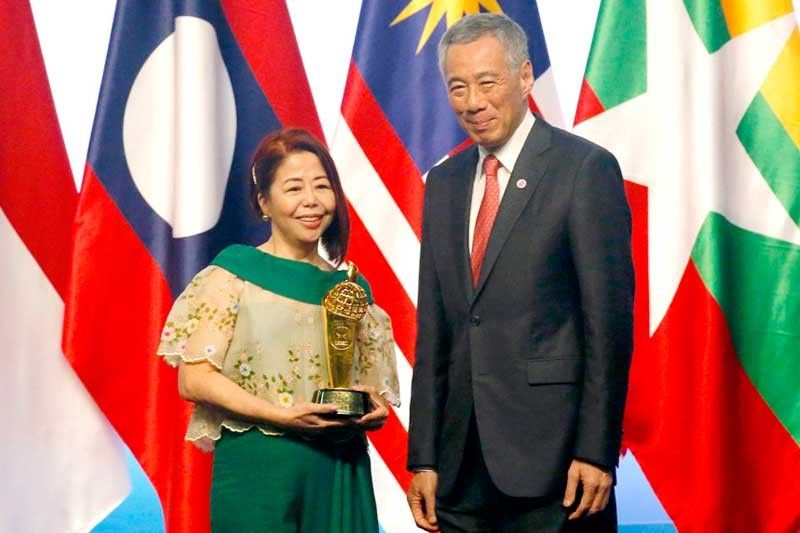
SINGAPORE – A Filipina mother who has pushed for the rights of persons with autism is the first recipient of the ASEAN Prize in honor of her exemplary contributions to an inclusive ASEAN community.

Singaporean Prime Minister Lee Hsien Loong poses with Erlinda Uy Koe, chair emeritus of the Autism Society-Philippines, during the opening ceremony for the 33rd Asean Summit and Related Summits last Tuesday.AP

President Duterte congratulated Erlinda Uy Koe, who was given the award during opening ceremonies of the 33rd ASEAN summit at the Suntec Singapore Convention and Exhibition Center on Tuesday night.

Koe became emotional when interviewed by members of Philippine media covering the summit after she received the award from no less than Singapore Prime Minister Lee Hsien Loong and ASEAN secretary-general Dato Lim Jock Hoi.

Koe, chair emeritus of the Autism Society of the Philippines (ASP), was nominated for her family autism advocacy.

The ASP’s “Angels Walk for Autism 2018” gathered 24,000 participants early this year, while thousands more converged in simultaneous walks in 10 cities.

Pinoy farmer finalist in International Cocoa Awards

Filipino farmer makes it to the finals of 2019 International Cocoa Awards Antonio Colina Manila Bulletin 18 August 2019 DAVAO CITY ...