Showing posts with label banking. Show all posts

Thursday, May 2, 2019

PH: Potentially Asia's fastest growing economy

Philippines has 'potential' to become Asia's fastest-growing economy: ADB

Cathy Yang
ABS-CBN News
02 May 2019 

NADI, Fiji -- The Philippines has the "potential" to become the fastest-growing economy in Asia, propelled by an unprecedented infrastructure overhaul, tax reform and a young workforce, the Asian Development Bank said Thursday.
A recent credit rating upgrade from S&P Global is also an indication of the "fundamental strength" of the Philippine economy, which has maintained growth at above 6 percent, said ADB Chief Economist Yasuyuki Sawada.
The Philippines' GDP growth has been among Asia's fastest, racing China and Vietnam. Official first quarter GDP numbers are due out on May 9, the same day as the Bangko Sentral ng Pilipinas' policy-setting meeting.
"It's quite possible for the Philippines to be the fastest-growing economy in Asia," Sawada told ANC. Debt is "well under control" and over-all fundamentals are "quite strong," he said.
The Philippines' work pool is also English-proficient and among the youngest in the region, with an average age of 28. Sawada said this would serve the needs of technology and business process outsourcing companies.
TRADE WAR RISK
The trade war between the US and China poses the "highest risk" to economic growth in Asia.
Should growth in China slow down because of the trade dispute, it could adversely impact the region indirectly, Sawada said on the sidelines of the ADB Annual Meeting here.
The same slowdown, however, could provide Asian economies an opportunity to offer themselves as an alternative to China, he said.
"The overall impact to Asian economies is rather moderate and strictly speaking, slightly positive," he said.
The Asia-Pacific region is the "global engine" for growth, contributing 60 percent to the world's economic expansion, he said.
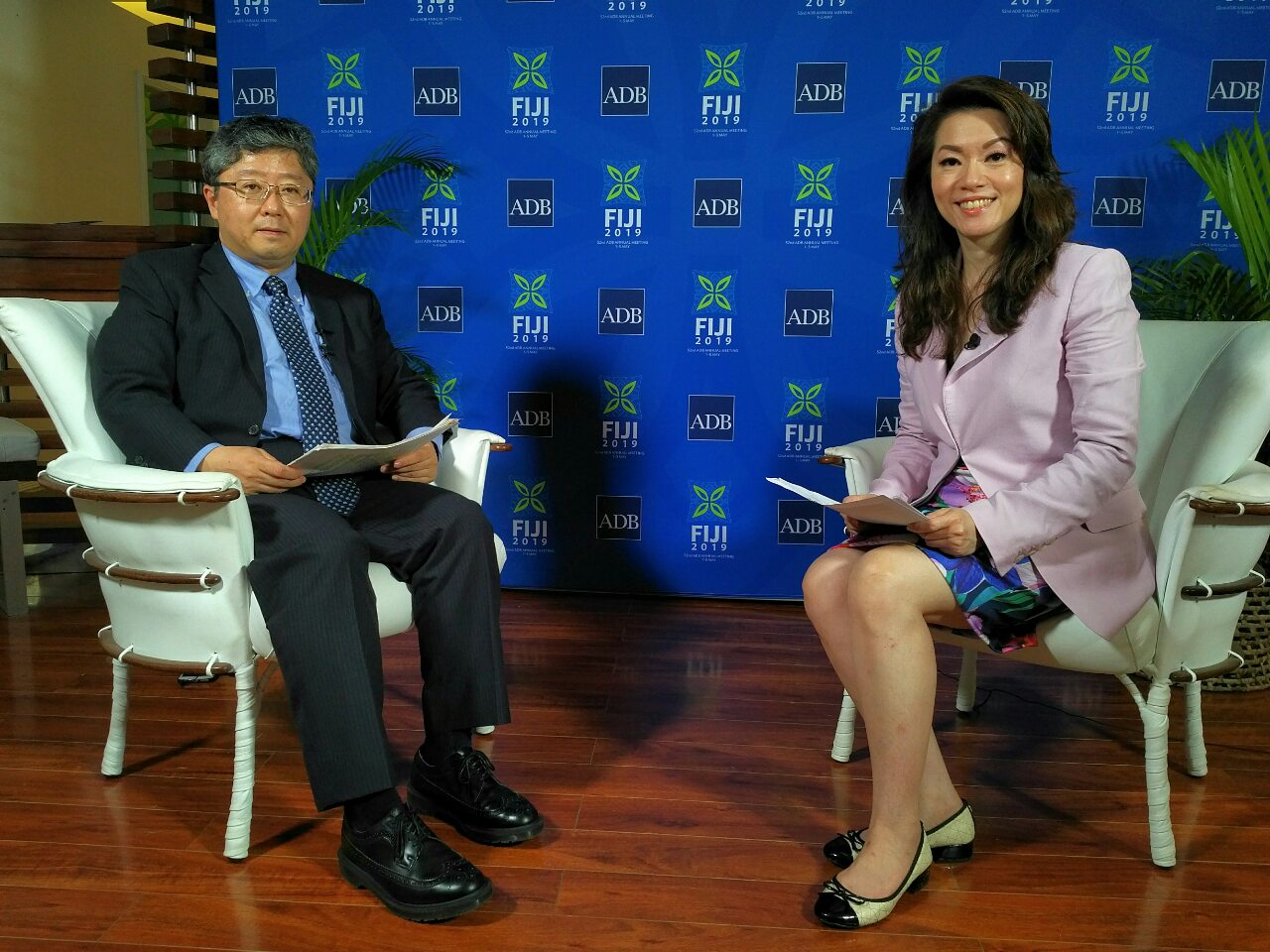
ADB Chief Economist Yasuyuki Sawada speaks to ANC's Cathy Yang on the sidelines of the Asian Development Bank's annual meeting in Nadi, Fiji. ABS-CBN News
DISASTER RESILIENCE
Disaster-prone countries like the Philippines should consider resilience when building new infrastructure.
A recent earthquake in Central Luzon killed over a dozen people and damaged Clark Airport, highlighting the country's location in the Pacific "Ring of Fire." The Philippines is also battered by an average of 20 typhoons per year.
"Building back better is a concept, after the disaster, putting back society and the economy in a better situation than the status quo prior to the disaster," he said.
"I think this shift in focus is quite an important element of building back better," he said.\
In a statement in Manila, Presidential Spokesman Salvador Panelo said Malacanang was "pleased" with the S&P Global upgrade.
"The economic team of the President has done a splendid job in putting the economic house in order and spearheading bold economic reforms, in cooperation with Congress, in bolstering the domestic economy, which is projected to become the world's top 25 economy," he said.

Sunday, March 3, 2019

Asia's best currency in February 2019

Philippine Peso Surprises to Become Asia’s Best Currency

David Finnerty
Bloomberg| 03March 2019


The Philippine peso has defied a yawning current-account deficit to emerge as Asia’s best-performing currency in February. And it may continue to surpass its peers.
Peso bulls say record remittances, rising investment and a buoyant domestic economy will propel further gains in the currency. Easing inflation could also lend a hand, as higher real yields burnish the appeal of Philippine bonds.
The peso is among Asia’s biggest turnaround stories, as the currency bounced back from a 13-year low after a slew of economic reforms and a $170 billion infrastructure spending plan revived sentiment. Proactive central bank policy has also helped win over skeptics.
“The peso has been stronger recently and could continue to outperform in the region, amid sustained net foreign portfolio investments on a widely expected further declining trend of local inflation," said Mike Ricafort, economist at Rizal Commercial Banking Corp. in Manila.
The Philippine currency strengthened 0.8 percent in February to 51.70 per dollar, the best performance among Asian currencies. It has climbed since the start of the year, as a pause in Federal Reserve tightening and easing global trade tensions fueled demand for developing-nation assets.
The peso was among the hardest hit in the emerging-market sell-off last year, tumbling to a 13-year low of 54.41 in October as investors punished economies running current-account deficits.
Technicals back the case for further peso gains. The dollar-peso currency pair remains in a bear trend, hovering above initial support at 51.90, its Feb. 13 low. The pair’s slow stochastics, a momentum indicator, signals it may drop further in the near term, with the %D line reading 43 and falling.
Sentiment toward the peso has recovered even after the central bank forecast the nation’s current-account deficit will widen to 2.3 percent of gross domestic product in 2019, the biggest shortfall since 2001. The recent rebound in crude prices threatens to worsen the gap, as the Philippines imports almost all its oil requirements.
Investors are betting on the peso after foreign investment into Philippine stocks and bonds recorded a net inflow of $763 million in January, more than four times the level a year ago. Remittances from Filipinos working abroad climbed to an all-time high of $2.85 billion in December.
Inflation data due March 5 could provide more fodder for peso bulls. Consumer-price gains may have eased to a one-year low of 4.0 percent in February, according to a Bloomberg survey of economists on Friday afternoon, and within the central bank’s target band of 2 to 4 percent. Price pressures have waned since touching a nine-year high in September, thanks to government measures to boost food supplies.
This augurs well for peso government bonds, which gained 0.4 percent in February, the seventh-best performer among 34 sovereign markets tracked by Bloomberg. Waning price pressures will boost real yields on Philippine debt, particularly as the central bank remains in hawkish mode for now.
Ten-year peso bonds offer a real yield of 2 percent, compared with about 5 percent for Indonesian securities and Indian debt.
But for peso bears, the outlook is less certain.
— With assistance by Ditas B Lopez, and Masaki Kondo

Pinoy farmer finalist in International Cocoa Awards

Filipino farmer makes it to the finals of 2019 International Cocoa Awards Antonio Colina Manila Bulletin 18 August 2019 DAVAO CITY ...