Showing posts with label language. Show all posts

Wednesday, July 31, 2019

Baybayin: Ancient Filipino script making a comeback

Beyond ABCs: Ancient Philippine script revival kicks up debate


Baybayin is making a comeback among the nation's millennials and young professionals

Gulf News|AFP
31 July 2019

190731 baybayin
Taipan Lucero doing calligraphy using the indigenous script known as Baybayin. Image Credit: AFP

Manila: With deliberate golden strokes, artist Taipan Lucero proudly brings an ancient script back to life, in the hope of promoting an endangered but contentious part of the Philippines' heritage.


Once confined to history classes, Baybayin, a 17-character indigenous script used before Spanish colonisation, is making a comeback among the nation's millennials, young professionals and diaspora.

Even as technology renders writing by hand outdated, online clips of calligraphy and digital fonts for the script have gripped the smartphone generation and now Baybayin — last used hundreds of years ago — is appearing on everything from tattoos and t-shirts to mobile apps.


Proponents hail the curvilinear text as a crucial part of Philippine identity, but in a country with 131 government-recognised languages - critics say investing in the promotion of one ancient text over others is controversial and impractical.

"It's bittersweet. It made me proud knowing our ancestors were literate," said Lucero, who studied calligraphy in Japan but returned home to apply his skills to reviving Baybayin.


The heart and soul of a country is its culture. The problem is that we don't value it due to our colonial mentality

- Kristian Kabuay| Filipino-American Baybayin artist

"What's sad about this is what's being propagated in our education system. It's like our history started with being colonised by Spain," the 31-year-old added.

Baybayin was the form of writing used before the Spanish arrived in 1521 and missionaries had to learn it initially to spread Catholicism before forcing locals to adopt their Roman alphabet, historians say.

Its resurgence has prompted calls from some for a law declaring Baybayin the national script. But regional scholars say the text is important mainly to Tagalogs — the people historically based in and around the capital — rather than to all Filipinos.
'Wiped out'
Advocates say reviving Baybayin will provide an antidote for a nation grappling with its colonial past and is a way of celebrating indigenous history.
Many are proficient in English because of the American occupation - Spain ceded control to the US in 1898 - and the Philippines only became independent in 1946.

190731 leo emmanual castro
Cultural advocate Leo Emmanuel Castro teaching students the indigenous script known as Baybayin Image Credit: AFP
"It's a great achievement to invent our own writing system," Leo Emmanuel Castro, executive director of cultural group Sanghabi, told AFP.

"Our language is gender-neutral. Professions and pronouns have no sex whereas English is very sexist," he added.
The campaign to bring Baybayin to the mainstream advanced in January when the lower house passed a bill mandating its use in signs and educational materials. It stalled in the Senate but the proposal has been refiled in the new session that started in July.
Holiday hotspot Boracay island has already ordered the use of Baybayin in signage, in a bid to counter the profileration of Chinese characters for tourists.

Cultural advocates

However, regional cultural advocates say such efforts threaten all of the nation's indigenous scripts.
Their anger is rooted in a 1937 proclamation that Tagalog be the basis of the national spoken language now called Filipino, and they see the revival of the Baybayin text as another blow for the nation's linguistic diversity.
"The Philippines has become a country only for the Tagalogs," explained Michael Pangilinan, an advocate of the Kulitan script of Pampanga province, who warned local identity would be "completely wiped out" if using Baybayin becomes mandatory.
"The Philippine state makes us ashamed of who we are until the Kapampangan people themselves are the ones repressing their own language and culture to become Filipinos (Tagalog)," he said in an e-mail to AFP.
Of the 17 documented Philippine syllabaries - systems of consonant and vowel syllables - only four remain in use among indigenous communities today, according to UNESCO.

Mere novelty?

190731 baybayin script
A piece of bamboo inscribed with indigenous Baybayin script. Image Credit: AFP
"When it comes to a national discussion, you need to use the dominant language known by the majority," countered Jay Enage, chairman of Baybayin Buhayin, a group lobbying for the bill.

But the practicalities of bringing a historic script into modern use, teaching it in schools, and honing it to fit places of work and 21st century life, may be the biggest challenge.

"It will just be a novelty, for display," said Joselito Delos Reyes, professor of creative writing and popular culture at Manila's University of Santo Tomas.

"It won't be a platform for communication," he added, saying lawmakers should instead prioritise improving education infrastructure and teachers' salaries.

Virgilio Almario, chairman of government commissions on language and culture, said it was important to walk the line between losing scripts to extinction and being practical about usage.

"We need to balance this carefully. We need Filipino as a bridge language but we should also appreciate the languages of all communities," he said.

Multi-lingual

190731 baybayin alibata
Image Credit: Baybayin.com


More than division, advocates say Filipinos should see opportunity in belonging to a multilingual country.

"The heart and soul of a country is its culture. The problem is that we don't value it due to our colonial mentality," Filipino-American Baybayin artist Kristian Kabuay told AFP.

Asked if the current Baybayin resurgence is just a fad, calligrapher Lucero insisted it was vital Filipinos take the time to understand the script's importance.

He added: "It's part of our culture and our identity and if we forget about it, we throw away part of ourselves."

Thursday, May 2, 2019

Filipino is Asia's sexiest accent

Filipino hailed as ‘sexiest accent’ in Asia 


Jan Milo Severo
Philstar.com
May 2, 2019


MANILA, Philippines — A travel and food website announced that Filipino is the sexiest accent in Asia and 21st sexiest accent in the world, according to its survey.

Big 7 Travel recently unveiled their survey results, Top 50 Sexiest Accents in the World, based on their readers’ opinion.

“Gentle and soft, the accents you’ll hear when in the Philippines are simply lovely,” the website described the Filipino language. 
New Zealand’s Kiwi was hailed as the world’s sexiest accent, followed by South African, Irish, Italian, Australian, Scottish, French, Spanish, South American and Brazilian Portuguese.

“To a novice ear, the New Zealand accent might sound just like the Australian accent, but Big 7 Travel readers disagree. The ‘Newzild’ dialect is outrageously charming,” Big 7 Travel wrote.

In the Asian ranking, the Philippines is followed by Vietnamese and Indian, placing 25th and 26th respectively. Japanese and Chinese, meanwhile, are in the 42nd and 43rd places respectively.
 

Saturday, December 8, 2018

Learn English in Asia

You Might Want to Head to Asia to Learn English


Anas Alzharani
Asia Media International
08 December 2018

When non-native English speakers decide to learn English in a different country, the first locations that come to mind are the U.S and England, where English is the first language. Command over the English language is fundamental across the globe; it influences our professional and personal lives, including traveling. People are less likely to consider Asian countries although some have proven themselves to provide high -quality English educational tools. 
You Might Want to Head to Asia to Learn English
To have another language is to possess a second soul.” – Charlemagne
Recently, Singapore ranked number three on a survey conducted by Education First (EF), which is an international school that focuses on languages, cultural exchange, and educational travel. The survey covered 1.3 million people from 88 countries that transact heavily in the English language.

Which Asian countries to consider?

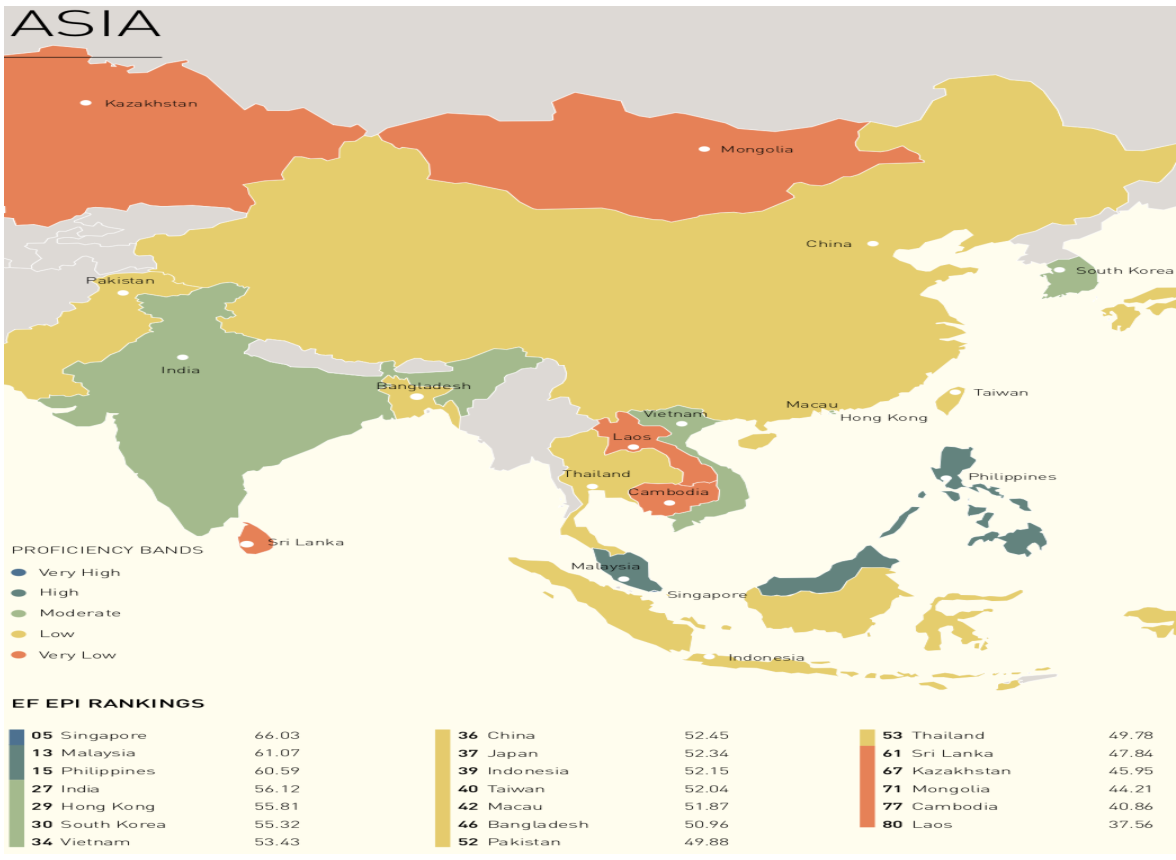
The Asian continent is vast, multicultural, and diverse. Singapore is an island city-state off southern Malaysia. It is a global financial center with a multicultural population. Singapore’s number three ranking for English proficiency was based on the Common European Framework of Reference (CEFR) and EF’s course levels. Two other Asian countries rated highly or moderately proficient in English: the Philippines and Hong Kong. 
The graph presents EF English Proficiency Index of Asian countries. EF EPI is based on test data of the EF Standard English Test (EF SET). EF EPI score is calculated by the used of 100 point scale of the EF SET and the regional averages. Based on the result, it attributed countries, regions, and cities to proficiency bands. 

A new era of learning the foreign languages

Learning another language opens the road to new cultures, lifestyles, and adventures. It also enables people to expand international connections. Study abroad is the key, or at least a very good bet, for young people to learn a foreign language. And that key may in addition open the door to a better future.
Like Nelson Mandela said, “If you talk to a man in a language he understands, that goes to his head. If you talk to him in his own language, that goes to his heart.”


Wednesday, October 31, 2018

PH English Proficiency

Singapore tops Asia in English skills after 

Philippines, Malaysia,India


Singapore tops in Asia with 68.43 score in English skills. Graphics courtesy: EF EPI

Singaporeans possess the highest degree of English skills in Asia, followed by people from the Philippines, Malaysia, and India, according to a new study.

Globally, among the non-English countries, Singapore is third after Sweden and Netherlands on "Very High" English proficiency Index that lists ten countries from Europe, besides Singapore and South Africa, according to a ranking released by EF EPI. The EF English Proficiency Index attempts to rank countries by the average level of English language skills amongst those adults who took the EF test.
Singapore ranks 3rd among 12 countries in

Singapore ranks 3rd among 12 countries in "Very High" English proficiency band Graphics courtesy: EF EPI

"With rapid growth in trade and technology, Asian countries with strong English proficiency are thriving. Singapore, which has consistently scored in the top 10 of the EF EPI, has had a trade to GDP ratio of over 300% since 1960. Although India is better-known for offshore services, it is the Philippines, with less than 10% of India’s population, which has the larger number of call centers," it says.

The ranking for the year 2018 was released after collating results from 1.3 million people spread over 88 countries and regions who took the test on its online proficiency testing portal. The proficiency is divided in five bands: Very High, High, Moderate, Low, and Very Low.

The study has thrown up some interesting results such as societies that speak English are "more open, less hierarchical and fairer to women." But it hastens to add that English per se cannot be said cause these societal improvements.
"The correlation makes sense. English breaks down barriers, fosters international exchange, and exposes individuals to the wider world," it says.

Women are found to speak better English than men. Though last year the men did narrow the gap, this time women are again in a clear lead.
But despite that "women speak less in meetings and negotiations than men and are interrupted more when they do speak."

"Research into how boys and girls learn foreign languages has shown that female students are more motivated, use a wider variety of strategies to retain new information, and are more willing to make mistakes. Women, on the whole, are also more likely than men to finish secondary school and attend university. Unfortunately, businesses are not benefitting as much as they could from women’s English skills," it points out.

Asia straddles all five proficiency bands with three countries in the upper quartile of the index and four in the bottom ten per cent. But English proficiency did not improve despite high level of investment in Asia.

"Singapore improved from an already strong base, moving into the third position in the overall ranking. China and Japan did not experience significant changes, and both remain in the Low Proficiency band. The lack of English skills in Central Asia became clearer this year with the addition of Uzbekistan to the index, which, along with Kazakhstan, falls in the Very Low Proficiency band," it notes.
Level of English proficiency vis a vis tasks that one can perform Graphics courtesy: EF EPI
Level of English proficiency vis a vis tasks that one can perform Graphics courtesy: EF EP

India missed High Proficiency band with one notch, thus sits at 28th global position atop Moderate proficiency band. The study points to inability of a very large, but poor workforce that can not afford decent education. Multiple ethnicity speaking 22 native languages also seems to have made English compete for space in India which made a head start in global IT outsourcing business because of its clear advantage of a large English speaking population. Its perceived rival in offshore business hiring, China, still sits in Low proficiency band despite major policy initiatives by the government ahead of Beijing Olympics.
EP EFI finds a high correlation between English proficiency and ability of a country to attract, develop, and retain skilled workers. "English proficiency allows local talent to participate in global conversations and is also critical in attracting talent from abroad. A 2017 HSBC survey ranked Singapore, Norway, Germany, and the Netherlands, all very high English proficiency countries, in the top five for their appeal to internationally mobile professionals. While attracting expats is not every region’s priority, nurturing local talent certainly should be." it says.
The eighteen countries listed in Asia are evenly divided between nine that improved and nine that did not. Singapore and Cambodia posted significant increases in their scores this year, while Bangladesh experienced a significant decrease. Only Sri Lanka and Macau SAR moved from a lower proficiency band to a higher one.
The study also claims English and innovation go hand in hand.
"More scientific journals are published in English than in any other language, and we’ve found consistent correlations between English and investment in R&D. This relationship is particularly interesting in light of recent research showing that companies with managers from many countries earn more of their revenue from innovation than less diverse competitors. English is changing the way that ideas flow from one place to another."
However, while EF EPI insists on numbers it is silent on the qualitative aspect of research and innovation as some of the revolutionary innovations have indeed come from countries that never use English as medium.

Pinoy farmer finalist in International Cocoa Awards

Filipino farmer makes it to the finals of 2019 International Cocoa Awards Antonio Colina Manila Bulletin 18 August 2019 DAVAO CITY ...