First Filipino-built train rouses pride, offers commuter relief
Art Fuentes
ABS-CBN NEWS
05 February 2019
MANILA -- Air-conditioned, big enough for 880 passengers and running on similar technology that powers Toyota's Pruis hybrid cars, the first Filipino-built train will be deployed in the first quarter, giving relief to thousands of commuters.
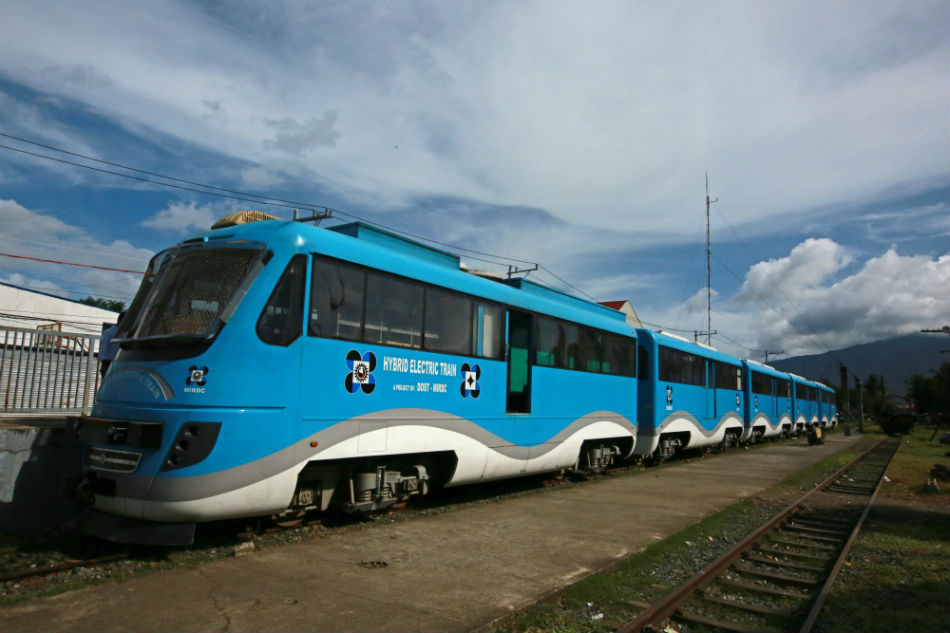 |
The Hybrid Electric Train (HET) built by the Department of Science and Technology is tested on the tracks of the Philippine National Railways (PNR) in Calamba, Laguna, Jan. 30, 2019. Art Fuentes, ABS-CBN News |
Built by the Department of Science and Technology, the Hybrid Electric Train (HET) took 5 years to develop and test and before the locomotives can be deployed on the Philippine National Railway (PNR) tracks, which stretches from Metro Manila to Laguna.
"Nakita namin na safe and reliable yung train natin kaya we are proud na pwede natin sabihin na comparable na yan sa imported ones na binibili natin na trains," said Pablo Acuin, a senior science research specialist at the DOST who headed the HET project.
(We saw that our trains are safe and reliable and we can say they are comparable to the imported ones that we buy.)
Currently, only 6 to 7 of the PNR's 11 train sets work on any given day, as 5 others undergo maintenance. Ideally, the PNR should have 15 trains, said the railway's spokesperson, Joseline Geronimo.
"Kami naman, syempre excited din kami kasi makakadagdag yan sa aming fleet," Geronimo said.
(We are excited to add more trains to our fleet.)
The PNR ordered 7 new train sets from Indonesia but these will not arrive until the middle of 2019. Acuin said the DOST-built trains could be in service by March.
The HET cost P120 million to develop, compared to the $47.4 million (P2.37 billion) cost of the Indonesian-made locomotives.
HOW IT STARTED
The hybrid electric train was conceived in 2012, according to Acuin. Back then, the DOST was helping PNR retrofit its fleet of locomotives.
“But we decided to develop a new train instead of retrofitting (the trains),” said Acuin.
To do this, the DOST assembled a team of engineers from various fields, as no one in the department had any experience working with locomotives, he said.
In 2013, the team came up with a design for a hybrid electrical train because they saw it as more energy efficient and environment-friendly.
The design called for a diesel-powered generator, an electric motor, a bank of electrical batteries, and what the engineers call regenerative braking technology.
Like Toyota’s Prius, the Filipino-built train taps kinetic energy normally lost when the train slows down or stops, and converts it to electricity which is then stored in 260 lead-acid batteries.
This stored energy can then be tapped to help propel the HET as well as power its automatic doors, aircon and onboard CCTV security system.
After coming up with the design, the team started looking for a local fabricator who can make the train coaches. While the engine, motor, and bogie (the train’s chassis, axle and wheels) will have to be sourced abroad, the coach could be made locally.
Fil-Asia Automotive and Industries Corp, which makes bus bodies and special trucks won the bidding to fabricate the train coaches.
The train's 5 coaches took less than a year to make, said Davie Ang, production manager for Fil-Asia. It took 2 years to integrate the train's different components and by the end of 2015, the trains were ready for testing.
It took another 2 years and 5,000 kilometers of performance tests to determine the HET’s reliability, availability, maintainability and safety before the DOST was ready to turn over the train to the PNR in 2018.
Unlike the trains of the MRT and LRT which run on elevated tracks, PNR trains face more challenging environments such as floods, said Geronimo, the PNR spokesperson.
POTENTIAL BUSINESS
With the administration of President Rodrigo Duterte actively promoting railways for mass transport, Acuin sees potential in tapping local engineers and fabricators to supply trains to these massive infrastructure projects.
The government’s infrastructure portal lists 5 major railway projects aside from the subway and light railway systems that have already broken ground or are under construction. These are the PNR North 1, PNR North 2, PNR South Commuter, PNR South Long Haul and the Mindanao Railway projects.
“We just need na magkaroon ng demand kasi, para yung industry mag-invest sila dun sa mga facilities na gagawa ng mga components o systems ng train,” Acuin said.
(We need demand so that there will be investments in facilities that build train components or systems.)
The DOST filed 4 patents during the course of developing the HET, underscoring how much local engineers learned while working on the project, he said.
Mass production will help bring train building costs further down, said Fil-Asia's Ang.
"Actually yun ang ina-eye namin. Kung mag mass produce si PNR, why not?" Ang said, adding that a train-building industry will also provide a lot of jobs for locals.
(Actually, that's what we are eyeing. If the PNR will mass produce, why not?)
If such an industry takes off, the DOST will no longer be involved as its mandate ends with research and development and transferring this technology to the private sector.
"Ang plano namin before, magbuo sila ng consortium o joint venture para in case na magpagawa ng PNR or any local government unit ng local train na ginawa natin, they have the materials, the financial capacity and manpower to create the train," Acuin said.
(Our plan before, was for a consortium or joint venture to be formed in case the PNR or any local government unit will want trains built, they will have the materials, the financial capacity and manpower to create the train.)