First Filipino New Zealand parliamentarian champions Pinoy values in maiden speech
MANILA, Philippines — Known for being competent construction workers, nursing home employees, information technology experts and engineers, Filipinos are now also excelling as lawmakers in New Zealand.
This is how lawyer and diplomat Paulo Garcia opened his historic maiden speech as the first-ever Filipino member of New Zealand Parliament.
“Nagmamahal na Panginoon, kami'y buong pusong nagpapasalamat na minarapat mong mabigyan ng pagkakataon ang inyong mga anak na makapaglingkod sa bayang New Zealand,” he began his speech in his native Filipino tongue.
“Hindi lamang sa mga nursing homes at ospital, sa mga dairy farms at construction sites, sa IT, engineering at hospitality. At ngayon pati na rin sa larangan ng pambabatas. Pagkalooban ninyo po kami ng puso, isip at katawan na matatag upang maisatupad namin ang inyong layunin para sa amin sa bansang New Zealand,” said the “KiwiNoy” who delivered his speech in Te Reo Maori, Filipino and English.
This is how lawyer and diplomat Paulo Garcia opened his historic maiden speech as the first-ever Filipino member of New Zealand Parliament.
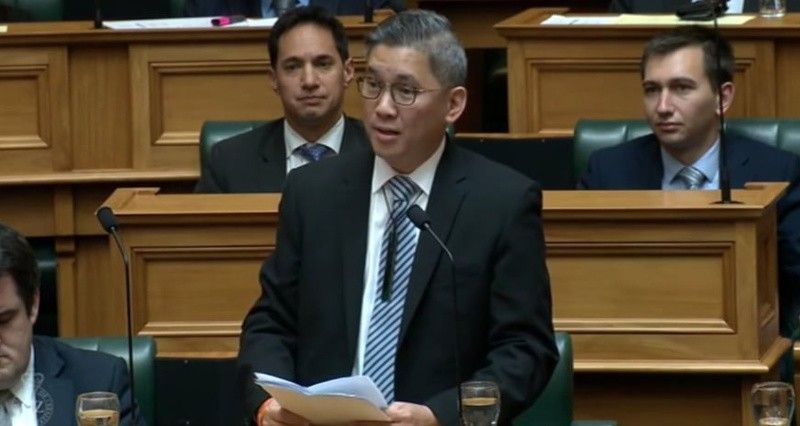 |
The first ‘KiwiNoy’ Member of Parliament Paulo Garcia delivers his historical maiden statement in Wellington, New Zealand in May 2019. In his speech, Garcia highlighted the innate values of being pro-God, pro-life and pro-family.
New Zealand Parliament, screenshot
|
“Hindi lamang sa mga nursing homes at ospital, sa mga dairy farms at construction sites, sa IT, engineering at hospitality. At ngayon pati na rin sa larangan ng pambabatas. Pagkalooban ninyo po kami ng puso, isip at katawan na matatag upang maisatupad namin ang inyong layunin para sa amin sa bansang New Zealand,” said the “KiwiNoy” who delivered his speech in Te Reo Maori, Filipino and English.
Read more at https://www.philstar.com/lifestyle/on-the-radar/2019/06/14/1926414/first-filipino-new-zealand-parliamentarian-champions-pinoy-values-maiden-speech#yVuxTfRoHg88kD0W.99
“We thank our loving God that he has given his children the opportunity to serve New Zealand not just in nursing homes and hospitals, in dairy farms and construction sites, in IT and engineering and hospitality but also now in the New Zealand Parliament.”
An immigrant who served as Philippine Honorary Consul General in 2012 in Auckland, Garcia was elected last May 16, following the resignation of National Party MP Nuk Korako.
“I am Paulo Garcia, I am Catholic, I am a Filipino and a New Zealander, and I am happy, excited, and blessed to be standing here before you. It is a privilege and an honor to work with all of you, and it is a testament to this great nation that migrants can become New Zealanders and represent this nation in our House of Parliament,” Garcia added.
Born in the Philippines and a graduate of the University of the Philippines, Garcia also studied in the University of Auckland and in Academy of American and International Law in Texas. He practiced commercial law for 10 years in Manila, focusing on foreign and multinational companies operating the country, before moving to New Zealand, where he practiced immigration law and investor migration for 14 years.
After working for McLeod & Associates and Corban Revell Lawyers, Garcia then founded his own law firm, Garcia Law, in New Zealand’s biggest city, Auckland.
“I have also I have been slandered and have been ostracized,” he added.
He recalled how hard his life had been as a migrant.
“Fourteen years ago, I was a struggling student at the University of Auckland law, taking papers and the bar exam. Those were tough times. We were a single income household of six,” he shared.
“But now here I stand as a Member of Parliament of this great nation… Many will say that I am living a dream. I disagree. This is not a dream; this is a Kiwi reality.”
Garcia expressed his gratitude for being voted to represent the ethnic Asian and the religious minority.
“That I am here tonight as the first member of the New Zealand Parliament of Filipino descent is a tribute to the National Party's recognition of strength in diversity and the value that ethnic communities bring to New Zealand—a New Zealand that holds itself out as open to all, where people from the world over are able to live without fear in the practice of their faith and values, and in observance of their cultural norms. This makes for a multicultural and ethnically diverse New Zealand. There is not a day that I wake up without giving thanks for being in New Zealand.”
In his speech, the Filipino lawmaker condemned religious intolerance as seen in Christchurch mosque shootings in Christchurch, New Zealand, last March, which killed 51 people.
“The evil man who aimed to drive religious intolerance into our midst must not be allowed to succeed. Equally, those who aimed to do the same in Sri Lanka when they attacked and killed hundreds of Catholic worshipers sought too to drive religious intolerance. Equally, they must not be allowed to succeed.”
“Whatever laws we might pass in this Chamber, the pro-life voice must no longer be despised and discounted as offensive. Preachers of tolerance and inclusion must no longer seek to silence and condemn those with opinions that make them uncomfortable but are nevertheless opinions based on another person's own beliefs and values systems. While we need to stay vigilant and investigate people who post offensive material online, we need to be equally concerned about any move in this House to restrict freedom of speech, a move which has all too often been used by those in power to silence those with differing opinions or ideas.”
He reminded Kiwis of the M?ori proverb “He tangata, he tangata, he tangata,” which says, “it is the people, it is the people, it is the people,” referring to “the most important thing in the world.”
“Even though we have evolved to be just and compassionate, we also have the evolved capacity for greed, anger, and hatred. All of us have the seeds of prejudice within us, but it is a question of which seeds we water and grow. There have been people who say my views are intolerant. Why? Because I am pro-life? Because I believe in the sanctity of life?”
Likewise, he quoted great Indian leader Mahatma Gandhi, who said that “the true measure of any society can be found in how it treats its most vulnerable members,” underscoring the importance of protecting the unborn.
“When it comes to human beings, we cannot pick and choose which ones are protected and which ones are not, and we cannot say some vulnerable lives must be protected but others not.”
He honored mothers who chose to give birth and raise their children despite the odds.
“I salute in absolute praise all single mothers. I can honestly say that if either my wife or I had had to raise our daughters alone, we would have struggled severely as well. Despite the due importance we all attach to this task in our hands—that of governing this country—parenting is the most important job we really have. As mothers and fathers and, collectively, as a Parliament and as a nation, we need to support our parents, we need to support our families, and we need to support our children, but I highlight that the men of this country need to do more. We as men need to stand strong in our relationships. We must be reliable providers and protectors. We must show tamariki the way to respect and honor women.”
He acknowledged that he would not have succeeded if not for his family’s love.
“I would not be here without the help of amazing examples of fortitude and courage. My mother, Anna, as she personally took loving care of my father over the 10 years he suffered dementia until his death. My father-in-law, Rene, who personally took loving care of my mother-in-law as she was struck by ALS until her passing… The love of my life, Malu, and my beloved daughters, who inspire me to give myself to others more and more every day, leaving nothing for myself.”
He concluded his speech with “Mabuhay” and with the poem “Identity” his daughter wrote: “A migrant house is built tall on foundations filled with sky, stacked with the hopes of generations into storeyed bastions that testify to us… We were made to hold together… I stand proud in the shade of a roof made for me to raise high by proclaiming I have a Spanish name, an American accent, and an Asian face… And I have been welcomed in Aotearoa.”
Garcia then received a standing ovation from the Members of Parliament at the end of his maiden speech and most of them lined up to shake his hand. The public gallery, filled with Filipinos, KiwiNoys and New Zealanders, celebrated his speech by singing and dancing to the tune of Orange and Lemons' "Pinoy Ako."
An immigrant who served as Philippine Honorary Consul General in 2012 in Auckland, Garcia was elected last May 16, following the resignation of National Party MP Nuk Korako.
“I am Paulo Garcia, I am Catholic, I am a Filipino and a New Zealander, and I am happy, excited, and blessed to be standing here before you. It is a privilege and an honor to work with all of you, and it is a testament to this great nation that migrants can become New Zealanders and represent this nation in our House of Parliament,” Garcia added.
Born in the Philippines and a graduate of the University of the Philippines, Garcia also studied in the University of Auckland and in Academy of American and International Law in Texas. He practiced commercial law for 10 years in Manila, focusing on foreign and multinational companies operating the country, before moving to New Zealand, where he practiced immigration law and investor migration for 14 years.
After working for McLeod & Associates and Corban Revell Lawyers, Garcia then founded his own law firm, Garcia Law, in New Zealand’s biggest city, Auckland.
Victory over hardship, discrimination
But Garcia’s road to power was not paved. Like many Filipino migrants, the lawyer admitted in his speech that he also “experienced hatred.”“I have also I have been slandered and have been ostracized,” he added.
He recalled how hard his life had been as a migrant.
“Fourteen years ago, I was a struggling student at the University of Auckland law, taking papers and the bar exam. Those were tough times. We were a single income household of six,” he shared.
“But now here I stand as a Member of Parliament of this great nation… Many will say that I am living a dream. I disagree. This is not a dream; this is a Kiwi reality.”
Garcia expressed his gratitude for being voted to represent the ethnic Asian and the religious minority.
“That I am here tonight as the first member of the New Zealand Parliament of Filipino descent is a tribute to the National Party's recognition of strength in diversity and the value that ethnic communities bring to New Zealand—a New Zealand that holds itself out as open to all, where people from the world over are able to live without fear in the practice of their faith and values, and in observance of their cultural norms. This makes for a multicultural and ethnically diverse New Zealand. There is not a day that I wake up without giving thanks for being in New Zealand.”
In his speech, the Filipino lawmaker condemned religious intolerance as seen in Christchurch mosque shootings in Christchurch, New Zealand, last March, which killed 51 people.
“The evil man who aimed to drive religious intolerance into our midst must not be allowed to succeed. Equally, those who aimed to do the same in Sri Lanka when they attacked and killed hundreds of Catholic worshipers sought too to drive religious intolerance. Equally, they must not be allowed to succeed.”
Respect for life
In his speech, Garcia also highlighted the innate values of being pro-God, pro-life and pro-family.“Whatever laws we might pass in this Chamber, the pro-life voice must no longer be despised and discounted as offensive. Preachers of tolerance and inclusion must no longer seek to silence and condemn those with opinions that make them uncomfortable but are nevertheless opinions based on another person's own beliefs and values systems. While we need to stay vigilant and investigate people who post offensive material online, we need to be equally concerned about any move in this House to restrict freedom of speech, a move which has all too often been used by those in power to silence those with differing opinions or ideas.”
He reminded Kiwis of the M?ori proverb “He tangata, he tangata, he tangata,” which says, “it is the people, it is the people, it is the people,” referring to “the most important thing in the world.”
“Even though we have evolved to be just and compassionate, we also have the evolved capacity for greed, anger, and hatred. All of us have the seeds of prejudice within us, but it is a question of which seeds we water and grow. There have been people who say my views are intolerant. Why? Because I am pro-life? Because I believe in the sanctity of life?”
Likewise, he quoted great Indian leader Mahatma Gandhi, who said that “the true measure of any society can be found in how it treats its most vulnerable members,” underscoring the importance of protecting the unborn.
“When it comes to human beings, we cannot pick and choose which ones are protected and which ones are not, and we cannot say some vulnerable lives must be protected but others not.”
He honored mothers who chose to give birth and raise their children despite the odds.
“I salute in absolute praise all single mothers. I can honestly say that if either my wife or I had had to raise our daughters alone, we would have struggled severely as well. Despite the due importance we all attach to this task in our hands—that of governing this country—parenting is the most important job we really have. As mothers and fathers and, collectively, as a Parliament and as a nation, we need to support our parents, we need to support our families, and we need to support our children, but I highlight that the men of this country need to do more. We as men need to stand strong in our relationships. We must be reliable providers and protectors. We must show tamariki the way to respect and honor women.”
He acknowledged that he would not have succeeded if not for his family’s love.
“I would not be here without the help of amazing examples of fortitude and courage. My mother, Anna, as she personally took loving care of my father over the 10 years he suffered dementia until his death. My father-in-law, Rene, who personally took loving care of my mother-in-law as she was struck by ALS until her passing… The love of my life, Malu, and my beloved daughters, who inspire me to give myself to others more and more every day, leaving nothing for myself.”
He concluded his speech with “Mabuhay” and with the poem “Identity” his daughter wrote: “A migrant house is built tall on foundations filled with sky, stacked with the hopes of generations into storeyed bastions that testify to us… We were made to hold together… I stand proud in the shade of a roof made for me to raise high by proclaiming I have a Spanish name, an American accent, and an Asian face… And I have been welcomed in Aotearoa.”
Garcia then received a standing ovation from the Members of Parliament at the end of his maiden speech and most of them lined up to shake his hand. The public gallery, filled with Filipinos, KiwiNoys and New Zealanders, celebrated his speech by singing and dancing to the tune of Orange and Lemons' "Pinoy Ako."