Showing posts with label GDP. Show all posts

Saturday, July 6, 2019

PH among the best place to live

Duterte's Philippines Among The Best Places To Live And Work, Ahead Of China

Panos Mourdoukoutas| Forbes.com
06 July 2019

Philippines has been ranked 24th best place to live and work, just behind the US, which ranked 23rd, and ahead of China, which ranked 26th.

That’s according to the 2019 HSBC Expat’s annual survey, which is based on responses from more than 18,000 expats across 163 markets on three metrics: living, career opportunity, and family life.

The Philippines jumped up the rankings from 26th place last year.

That may come as a surprise to some for a couple of reasons. One of them is that the Philippines has a reputation for sending its own people overseas in droves rather than attracting foreigners who want to live and work there.


The other reason is that the country is mired in violence, which has taken a huge human toll.

Apparently, that isn’t what foreign expats are concerned about. They find it easy to relocate to a country of friendly people and a reasonable cost of living. “With its tropical climate and steadily growing economy, the Philippines is quickly becoming one of the most popular expat destinations in Southeast Asia, “ says the report.
Indeed, the Philippines economy has been booming in recent years. The Philippines’ per-capita GDP was last recorded at an all-time high of 3,063 U.S. dollars in 2018, according to Tradingeconomics.com. And it’s expected to reach $3,277 by 2020. That’s well above the average of $1,653.98 for the period 1960-2018.
Filipinos are doing better in recent years when per-capita GDP is adjusted by purchasing power parity (PPP). That measure, too, reached a record 7,599.19 U.S. dollars in 2018, well above the average of $4969.71 for the period 1990-2018.
Statistic 2015 2017 2018 2020 (projected)
Per Capita GDP $2615.7 $2891.36 $3,063 $3,277
Per Capita GDP PPP 6874.4 7599.19 7599.19 --
GDP Annual Growth Rate 6.5% 7.2% 5.60 --

Meanwhile, a recent McKinsey Global Institute (MGI) study places the Philippines among the few emerging market economies that are well-prepared to achieve sustained growth over the next decade.
That's thanks to a rise in gross fixed-capital formation (investment).
Still, the Philippines’ per-capita GDP is equivalent to 23% of the world's average, which makes Filipinos poor.
Meanwhile, the results of the expats survey should be interpreted with extreme caution. People surveyed are usually more affluent and better educated than the average immigrant, and they are on short assignments. This means that an overseas assignment may be seen as an “adventure.”
And the Philippines is a good place for that, better than China, as other surveys confirm.

Thursday, June 27, 2019

PH powerhouse economy

‘PHL growth faster than regional powerhouses’

Rea Cu| Business Mirror
27 June 2019

GROWTH of the Philippine economy will be faster than other regional economic powerhouses under the Duterte administration, the Department of Finance (DOF) said on Wednesday, citing the World Bank (WB) for such projection.

The country’s strong macroeconomic fundamentals provide the basis for the Bank’s expectations that the Philippine economy will grow faster than China and Malaysia, the DOF said in a statement on Wednesday.

Finance Undersecretary Gil S. Beltran said the World Bank based its projections on the Philippines’s solid external stance and “highly domestically driven” economy, which provides it “ample cushion” against external headwinds that are generally foreseen to slow down global growth this year.

“The Philippines is also expected to remain as an attractive destination for foreign direct investments [FDI]. We are pushing for further liberalization of investment ownership in the country,” said Beltran, also the chief economist of the DOF.

According to World Bank forecasts, the Philippines’s gross domestic product (GDP) is expected to grow by 6.4 percent this year, second only to Vietnam’s 6.6 percent, and higher than China’s 6.2 percent, Indonesia’s 5.2 percent and Malaysia’s 4.6 percent.

In 2020 and 2021, the Philippines’s GDP growth of 6.5 percent for both these periods will equal Vietnam’s 6.5 percent, also for both periods, and surpass China’s 6.1 and 6.0 percent, respectively.

The Indonesian economy is projected to expand 5.3 percent for 2020 and 2021, while Malaysia will maintain its growth at 4.6 percent in both these years.

Based on an economic research published by Standard & Poor’s (S&P) Global Ratings for June entitled Apac Monthly Snapshots: Trade Wars and Currency Corners, the country’s GDP is seen to settle between 6 percent and 6.5 percent this year.

“We continue to expect GDP growth to come in at the low end of the 6 percent to 6.5 percent range in 2019, with a likely resumption of the infrastructure build in the second half of the year to bring the fiscal impulse for the year to around neutral after being negative in the first half of the year. We also expect BSP [Bangko Sentral ng Pilipinas] to maintain its easing bias this year, supporting growth, as inflation will likely stay benign especially compared to last year’s spike,” the economic research said.

Beltran noted that the country’s debt-to-GDP ratio also continued its downward trajectory on the Duterte watch despite its ambitious infrastructure buildup under its “Build, Build, Build” (BBB) program, with national government debt in relation to GDP at 42.1 percent in 2017, and falling further to 41.9 percent in 2018.

“Moreover, the Philippines has implemented monetary and nonmonetary policies to keep inflation manageable and bring it back to the government’s target range of 2 to 4 percent this year. Perceived overheating risks have abated, driven by government measures and policies,” Beltran said.

Fitch Ratings has also maintained its “BBB” with a stable outlook for the Philippines as of May this year, while Moody’s also affirmed its Baa2 with a stable outlook as of November 2018.

Friday, June 21, 2019

Philippines in Goldilocks economy

Philippines enters ‘Goldilocks’ economy phase — Diokno


Lawrence Agcaoili 
The Philippine Star
June 21, 2019 

Right mix of high growth, low inflation

MANILA, Philippines — The Philippines has entered a “Goldilocks” economy with the right mix of high economic growth and low inflation, according to Bangko Sentral ng Pilipinas Governor Benjamin Diokno.


In a speech during the Wallace Business Forum (WBF), Diokno said the Philippine economy has entered a state of having “just the right” mix of high growth and low inflation.

“In other words ladies and gentlemen, the Philippine economy continues to fire on all cylinders and is expected to see steady economic growth without possible risks of overheating,” Diokno said.

“In terms of financial stability, we want to maintain a Goldilocks economy by not allowing markets to create new risks and vulnerabilities. This means that we do not only concern ourselves with growth and price stability, but also take into account resiliency. Implementing measures that would further enhance the existence of flexible systems and develop financial markets remains a policy imperative,” Diokno also said.

The country’s gross domestic product (GDP) growth slipped to a four-year low of 5.6 percent in the first quarter from 6.3 percent in the fourth quarter of last year primarily due to the delayed passage of the 2019 national budget.

On the other hand, inflation averaged 3.6 percent from January to May – well within the BSP’s two to four percent target – despite the slight uptick in May to 3.2 percent from three percent in April.

Inflation accelerated to 5.2 percent last year from 2.9 percent in 2017 due to elevated oil and food prices as well as weak peso, exceeding the BSP target range of two to four percent.

This paved the way for a tightening cycle that saw interest rates rise by 175 basis points in five straight rate-setting meetings between May and November last year to prevent inflation from spiraling out of control.

The BSP, however, slashed interest rates by 25 basis points due to easing inflation and slower-than-expected GDP growth in the first quarter.

“This decision was aimed at helping inflation move toward the middle of the target range and give due consideration to growth, in line with the BSP’s flexible approach to inflation targeting,” Diokno said.

According to Diokno, GDP growth is expected to pick up in the second half with the catch-up government spending plan.

“This positive alignment between growth and inflation has been a constant narrative and is expected to further lend support to the country’s long-run growth momentum,” Diokno said.

Despite all these positive developments, Diokno said there are still challenges on the horizon as International Monetary Fund chief Christine Lagarde aptly puts it, “the global economy is at a delicate moment”—as we see uncertainty as well as lack of trust and confidence by the business community as to what the global economic landscape is going to be.

The IMF has revised downward its global growth forecast for 2019 to 3.3 percent from the previous target of 3.7 percent.

With global growth slowing, Diokno said advanced economies have shifted from a restrictive to a more accommodative stance of monetary policy and there is tendency in some economies to move away from globalization toward the rise of protectionist policies such as the protracted trade tensions between the US and China.

“While the Philippines is not directly affected with the tariff impositions, the continued trade friction could take its toll on the country’s external sector,” he said.

Sunday, June 9, 2019

PH in Proactive Tax Reform


WB lauds Philippines for ‘proactive’ tax reform


Mary Grace Padin 
The Philippine Star 
June 9, 2019 


MANILA, Philippines — A top World Bank official has lauded the Duterte administration for implementing a “proactive and forward-looking” tax reform program, which is seen to raise enough funding for the government’s infrastructure and social program and help sustain economic growth, the Department of Finance (DOF) said.


World Bank director of macroeconomics, trade and investment Lalita Moorty cited the Philippines’ accomplishments on the economic front, especially in implementing a tax reform program to enable the government to aggressively increase its investments on infrastructure and social services.

The DOF quoted Moorty, who said it was “quite a change” to see a country implementing a tax reform proactively, unlike some countries who only push for these reforms when they are in the middle of a fiscal crisis.

“It is actually quite a change to see a country that is taking a very forward-looking approach to reforms.The Philippines is posting really fast growth rates, about three times of what we see in Europe and Central Asia. I think this is a good time to do these tax reforms. It is a good time and you have seized it. That is quite impressive,” said Moorty during the Philippine Day Forum held in Washington DC last April 11.

According to the DOF, Moorty also commended the Philippine government’s sound fiscal policies as shown by its declining debt-to-gross domestic product (GDP) ratio amid sustained rapid growth and increased public spending.

“When I think about comparing the Philippines to other parts of the world, it has managed to do so much and grow so much while bringing its public debt-to-GDP ratios down. It’s very impressive that it went from over 50 percent to around 40 percent in a decade. That’s quite impressive, in contrast to other countries where we’re seeing a rise in the public debt-to-GDP ratio,” Moorty said.

 “All in all, I think this is such a strong and wonderful start when I look at the Philippines in comparison to other countries in the world and I do hope that this continues to progress and accelerate in the near future,” she said.

Finance Secretary Carlos Dominguez said actual disbursements for infrastructure and capital outlays reached P1.64 trillion in the first 10 quarters of the Duterte administration, outpacing the P1.57 trillion investments made by the previous administration in all of its six years.

 He said economic expansion averaged 6.5 percent in the same first 10 quarters.

The country’s debt-to-GDP ratio, meanwhile, continued its downward trend to 41.9 percent last year from 68.5 percent in 2005, and is expected to further decrease to 38.6 percent by 2022, Dominguez said.

Dominguez said the national government’s revenues rose by 15 percent to P2.85 trillion in 2018, while tax revenues grew 14 percent to P2.57 trillion.

This translated into a tax effort of 14.7 percent last year, which is now the highest the government has ever achieved in the past 20 years.

Revenues from the Tax Reform for Acceleration and Inclusion (TRAIN) Law, the first package under the Duterte administration’s comprehensive tax reform program, reached P68.4 billion in 2018, higher than the full-year target of P63.3 billion.

Sunday, May 12, 2019

PH in 7% Club

Asian Economies Set to Dominate 7% Growth Club During 2020s


Thursday, May 2, 2019

PH: Potentially Asia's fastest growing economy

Philippines has 'potential' to become Asia's fastest-growing economy: ADB

Cathy Yang
ABS-CBN News
02 May 2019 

NADI, Fiji -- The Philippines has the "potential" to become the fastest-growing economy in Asia, propelled by an unprecedented infrastructure overhaul, tax reform and a young workforce, the Asian Development Bank said Thursday.
A recent credit rating upgrade from S&P Global is also an indication of the "fundamental strength" of the Philippine economy, which has maintained growth at above 6 percent, said ADB Chief Economist Yasuyuki Sawada.
The Philippines' GDP growth has been among Asia's fastest, racing China and Vietnam. Official first quarter GDP numbers are due out on May 9, the same day as the Bangko Sentral ng Pilipinas' policy-setting meeting.
"It's quite possible for the Philippines to be the fastest-growing economy in Asia," Sawada told ANC. Debt is "well under control" and over-all fundamentals are "quite strong," he said.
The Philippines' work pool is also English-proficient and among the youngest in the region, with an average age of 28. Sawada said this would serve the needs of technology and business process outsourcing companies.
TRADE WAR RISK
The trade war between the US and China poses the "highest risk" to economic growth in Asia.
Should growth in China slow down because of the trade dispute, it could adversely impact the region indirectly, Sawada said on the sidelines of the ADB Annual Meeting here.
The same slowdown, however, could provide Asian economies an opportunity to offer themselves as an alternative to China, he said.
"The overall impact to Asian economies is rather moderate and strictly speaking, slightly positive," he said.
The Asia-Pacific region is the "global engine" for growth, contributing 60 percent to the world's economic expansion, he said.
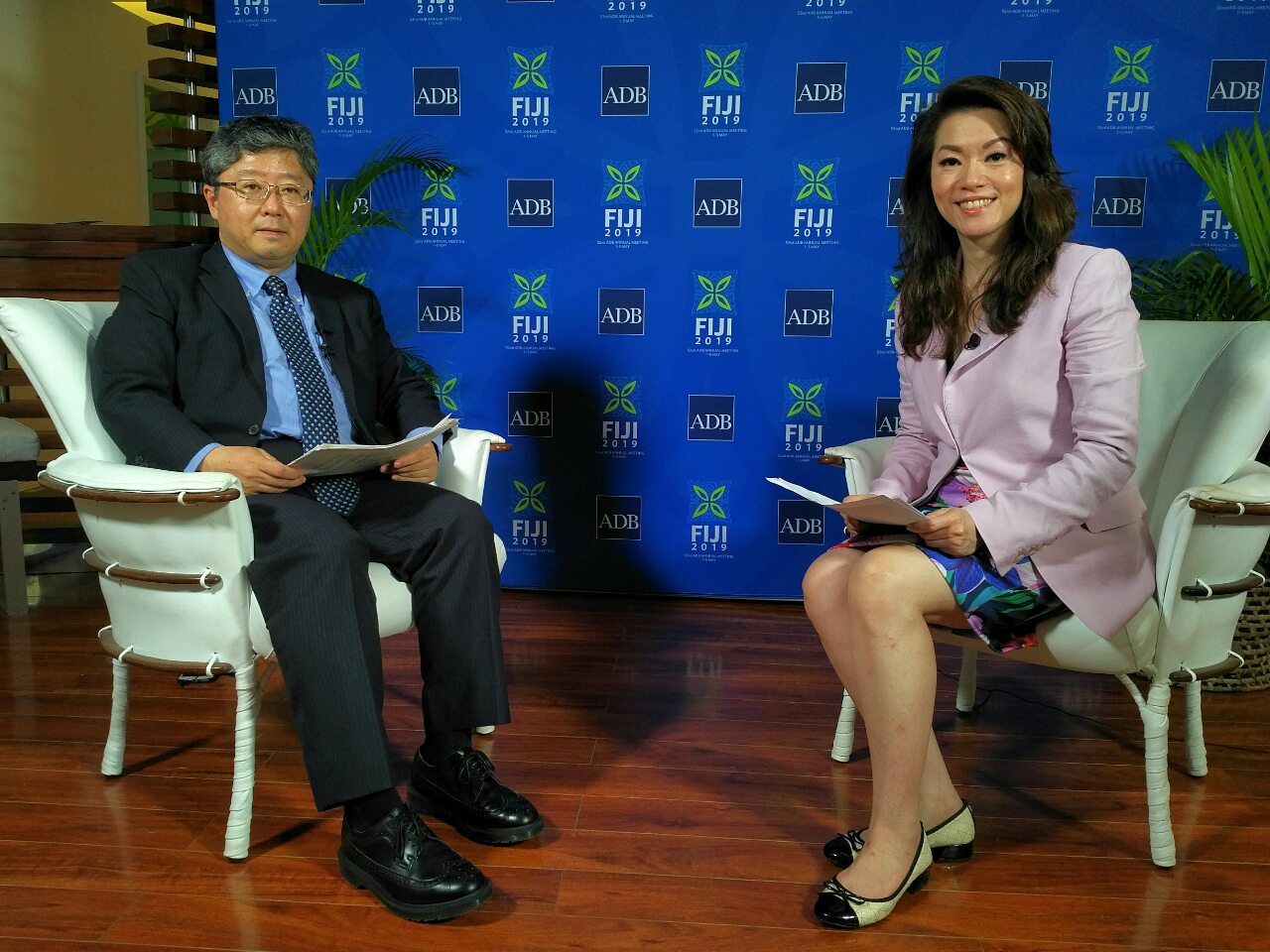
ADB Chief Economist Yasuyuki Sawada speaks to ANC's Cathy Yang on the sidelines of the Asian Development Bank's annual meeting in Nadi, Fiji. ABS-CBN News
DISASTER RESILIENCE
Disaster-prone countries like the Philippines should consider resilience when building new infrastructure.
A recent earthquake in Central Luzon killed over a dozen people and damaged Clark Airport, highlighting the country's location in the Pacific "Ring of Fire." The Philippines is also battered by an average of 20 typhoons per year.
"Building back better is a concept, after the disaster, putting back society and the economy in a better situation than the status quo prior to the disaster," he said.
"I think this shift in focus is quite an important element of building back better," he said.\
In a statement in Manila, Presidential Spokesman Salvador Panelo said Malacanang was "pleased" with the S&P Global upgrade.
"The economic team of the President has done a splendid job in putting the economic house in order and spearheading bold economic reforms, in cooperation with Congress, in bolstering the domestic economy, which is projected to become the world's top 25 economy," he said.

Pinoy farmer finalist in International Cocoa Awards

Filipino farmer makes it to the finals of 2019 International Cocoa Awards Antonio Colina Manila Bulletin 18 August 2019 DAVAO CITY ...