Showing posts with label culture. Show all posts

Friday, August 16, 2019

Jollibee in Edmonton


Popular Filipino fast food chain Jollibee opens in Edmonton to huge fanfare

Slav Kornik | Global News Canada
16 August 2019

The popular Filipino fast-food chain Jollibee opened its first restaurant in Edmonton to massive fanfare on Friday morning — the excitement was so great, a record was set.
Jollibee opening in Edmonton, Canada
Hundreds of people lined up for hours and even days just off Calgary Trail and 38 Avenue in south Edmonton to get the first taste of the restaurant’s food.
The crowd cheered, sang and danced shortly before the restaurant opened.

Jollibee-opening-aug-16-19
Jordan Haworth was the first in line after arriving at the restaurant at 9 a.m. on Tuesday, meaning he waited in line for nearly three days —which set a record for the longest wait at a Jollibee opening.
Jollibee store openings have been known to draw large crowds as fans and newcomers alike line up for a chance to try the unique food.
“I’m very very excited. People have been repping it all week,” Haworth, who hadn’t tried the company’s food before, said.
Jollibee Edmonton opening 9
“We have never seen this kind of opening at any of our locations before, probably the [previous] record we had was a 20 hour wait,” JFC North America Philippine branch president Maribeth Delacruz said.
“It was in Manhattan in New York, but somebody waiting in line for three days for the opening is just really phenomenal.”

Others drove several hours to get a taste of Jollibee’s food. The Filipino people who lined up said Jollibee is more than a fast-food restaurant, it’s a part of their native country.
“When you go to a mall with your family, you would eat at Jollibee. You would always eat there.”
The fast-food giant has been in the Philippines for 40 years, with around 1,000 restaurants world-wide.
The menu contains items that may be new to some Canadian palates: known as “the McDonald’s of the Philippines,” the restaurant has diverse offerings such as fried chicken, sweet-style spaghetti sauce and noodles, and peach mango pie.
“I just came from inside and somebody who waited for three days in line, and when she finally got to the counter she was literally crying,” Delacruz said.
The Edmonton restaurant is the fifth in Canada for the company. There are also two in Toronto and two in Winnipeg.
Those in line believe the new restaurant will be a huge hit in Alberta’s capital.
“Especially that it’s just one in Edmonton,” Angel Haddac said.
“And there’s a lot of Filipinos and other people that would like it,” Reyes added.
The company has aggressive expansion plans, with the goal of opening 100 restaurants in Canada over the next five years.

Wednesday, July 31, 2019

Baybayin: Ancient Filipino script making a comeback

Beyond ABCs: Ancient Philippine script revival kicks up debate


Baybayin is making a comeback among the nation's millennials and young professionals

Gulf News|AFP
31 July 2019

190731 baybayin
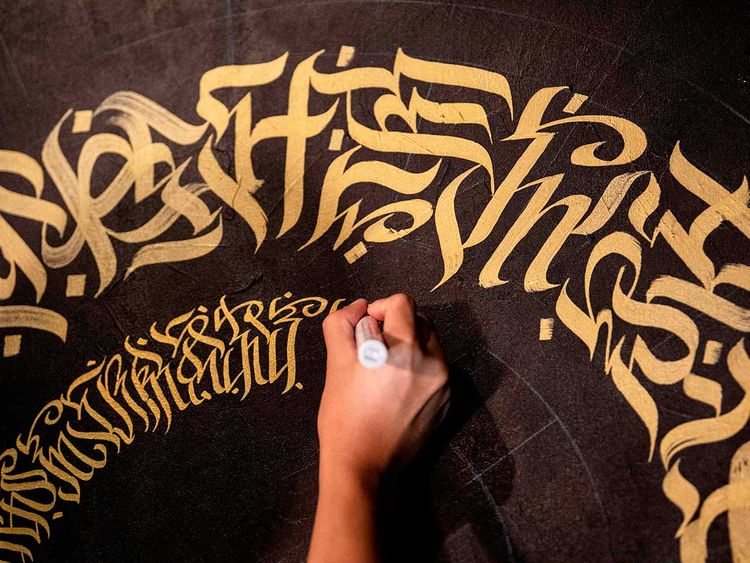
Taipan Lucero doing calligraphy using the indigenous script known as Baybayin. Image Credit: AFP

Manila: With deliberate golden strokes, artist Taipan Lucero proudly brings an ancient script back to life, in the hope of promoting an endangered but contentious part of the Philippines' heritage.


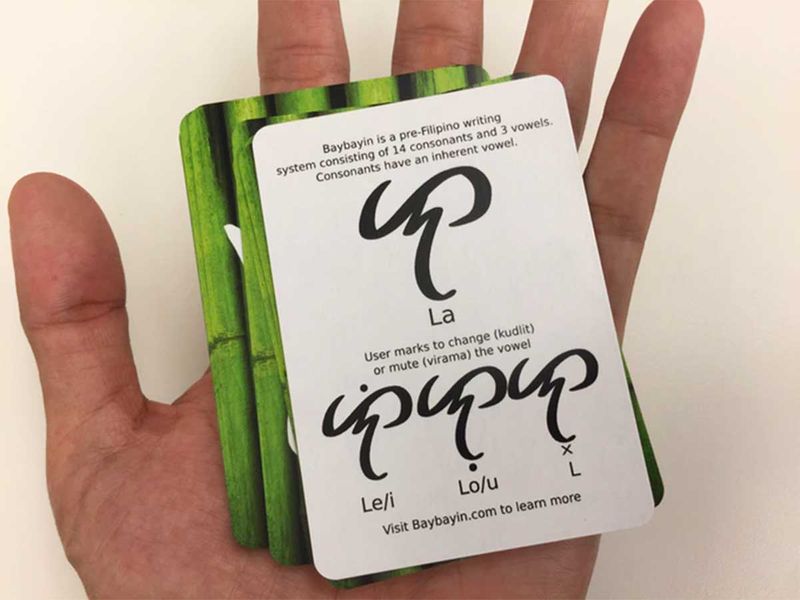
Once confined to history classes, Baybayin, a 17-character indigenous script used before Spanish colonisation, is making a comeback among the nation's millennials, young professionals and diaspora.

Even as technology renders writing by hand outdated, online clips of calligraphy and digital fonts for the script have gripped the smartphone generation and now Baybayin — last used hundreds of years ago — is appearing on everything from tattoos and t-shirts to mobile apps.


Proponents hail the curvilinear text as a crucial part of Philippine identity, but in a country with 131 government-recognised languages - critics say investing in the promotion of one ancient text over others is controversial and impractical.

"It's bittersweet. It made me proud knowing our ancestors were literate," said Lucero, who studied calligraphy in Japan but returned home to apply his skills to reviving Baybayin.


The heart and soul of a country is its culture. The problem is that we don't value it due to our colonial mentality

- Kristian Kabuay| Filipino-American Baybayin artist

"What's sad about this is what's being propagated in our education system. It's like our history started with being colonised by Spain," the 31-year-old added.

Baybayin was the form of writing used before the Spanish arrived in 1521 and missionaries had to learn it initially to spread Catholicism before forcing locals to adopt their Roman alphabet, historians say.

Its resurgence has prompted calls from some for a law declaring Baybayin the national script. But regional scholars say the text is important mainly to Tagalogs — the people historically based in and around the capital — rather than to all Filipinos.
'Wiped out'
Advocates say reviving Baybayin will provide an antidote for a nation grappling with its colonial past and is a way of celebrating indigenous history.
Many are proficient in English because of the American occupation - Spain ceded control to the US in 1898 - and the Philippines only became independent in 1946.
190731 leo emmanual castro
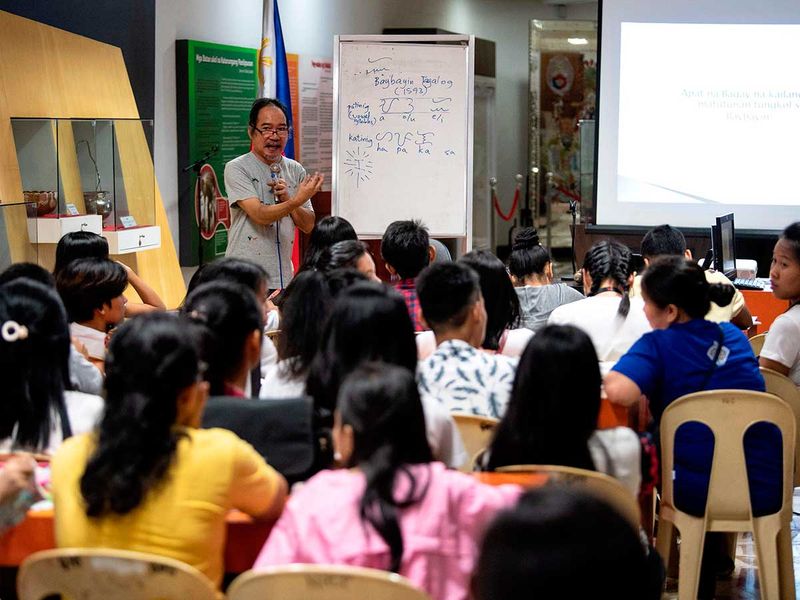
Cultural advocate Leo Emmanuel Castro teaching students the indigenous script known as Baybayin Image Credit: AFP
"It's a great achievement to invent our own writing system," Leo Emmanuel Castro, executive director of cultural group Sanghabi, told AFP.

"Our language is gender-neutral. Professions and pronouns have no sex whereas English is very sexist," he added.
The campaign to bring Baybayin to the mainstream advanced in January when the lower house passed a bill mandating its use in signs and educational materials. It stalled in the Senate but the proposal has been refiled in the new session that started in July.
Holiday hotspot Boracay island has already ordered the use of Baybayin in signage, in a bid to counter the profileration of Chinese characters for tourists.

Cultural advocates

However, regional cultural advocates say such efforts threaten all of the nation's indigenous scripts.
Their anger is rooted in a 1937 proclamation that Tagalog be the basis of the national spoken language now called Filipino, and they see the revival of the Baybayin text as another blow for the nation's linguistic diversity.
"The Philippines has become a country only for the Tagalogs," explained Michael Pangilinan, an advocate of the Kulitan script of Pampanga province, who warned local identity would be "completely wiped out" if using Baybayin becomes mandatory.
"The Philippine state makes us ashamed of who we are until the Kapampangan people themselves are the ones repressing their own language and culture to become Filipinos (Tagalog)," he said in an e-mail to AFP.
Of the 17 documented Philippine syllabaries - systems of consonant and vowel syllables - only four remain in use among indigenous communities today, according to UNESCO.

Mere novelty?

190731 baybayin script
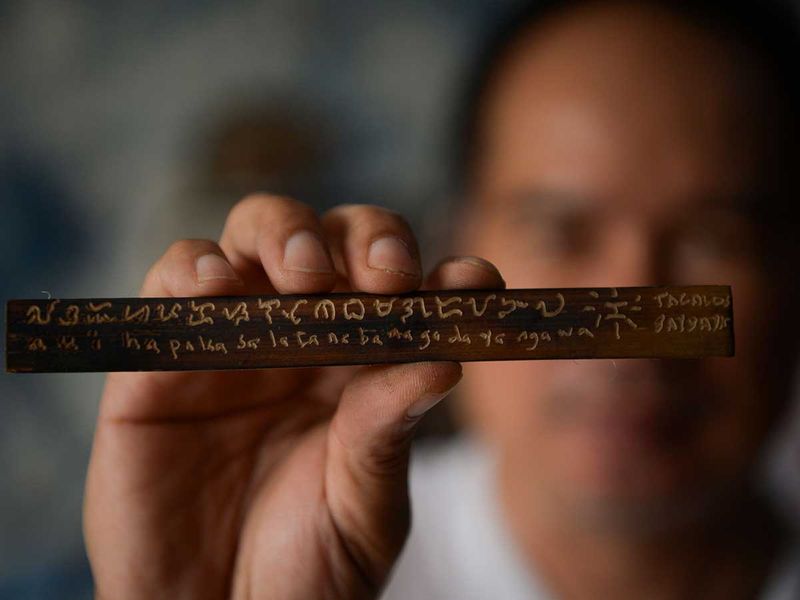
A piece of bamboo inscribed with indigenous Baybayin script. Image Credit: AFP
"When it comes to a national discussion, you need to use the dominant language known by the majority," countered Jay Enage, chairman of Baybayin Buhayin, a group lobbying for the bill.

But the practicalities of bringing a historic script into modern use, teaching it in schools, and honing it to fit places of work and 21st century life, may be the biggest challenge.

"It will just be a novelty, for display," said Joselito Delos Reyes, professor of creative writing and popular culture at Manila's University of Santo Tomas.

"It won't be a platform for communication," he added, saying lawmakers should instead prioritise improving education infrastructure and teachers' salaries.

Virgilio Almario, chairman of government commissions on language and culture, said it was important to walk the line between losing scripts to extinction and being practical about usage.

"We need to balance this carefully. We need Filipino as a bridge language but we should also appreciate the languages of all communities," he said.

Multi-lingual

190731 baybayin alibata
Image Credit: Baybayin.com


More than division, advocates say Filipinos should see opportunity in belonging to a multilingual country.

"The heart and soul of a country is its culture. The problem is that we don't value it due to our colonial mentality," Filipino-American Baybayin artist Kristian Kabuay told AFP.

Asked if the current Baybayin resurgence is just a fad, calligrapher Lucero insisted it was vital Filipinos take the time to understand the script's importance.

He added: "It's part of our culture and our identity and if we forget about it, we throw away part of ourselves."

Saturday, June 22, 2019

The Filipino Schindler (movie)

The Filipino Schindler: How the country's former president saved hundreds from the Holocaust

Chris Neebould
The National (UAE)
22 June 2019


In the opening scenes of Quezon’s Game, a newsreel plays harrowing images of concentration camps and the atrocities carried by the Nazi Party. As the reels plays, an ailing president of the Philippines, Manuel Quezon – head of a government in exile at the end of the Second World War – turns to his wife and asks: “Could I have done more?”

The real Manuel Quezon, who was president of the Commonwealth of the Philippines from 1935 to 1944. Alamy
It’s a fair assumption that most of the audience at screenings won’t know what he’s referring to. Is it his becoming the first elected president of a fully unified Philippines? 
His successful land reforms? His attempts to free the nation’s economy from the shackles of foreign ownership? His war on corruption? Or his leading of a ­government- in-exile in the US following the Japanese occupation of his homeland?

In fact, he’s not talking about any of these things, but about a little-known period in his presidency, one that doesn’t feature in many history books and remains a mystery to a vast majority of Filipinos.

Kate Alejandrino, right, stars as Maria Aurora “Baby” Quezon. Courtesy Film Freeway
Thanks to his actions, Quezon can reasonably be described as Asia’s equivalent of Oskar Schindler, the German industrialist credited with shielding more than 1,000 Jews from the Holocaust by employing them in his factories.

Between 1938 and 1941, Quezon concocted a plan with his American poker-playing buddies – Paul McNutt, the US high commissioner, Philippine residents and cigar magnates the Frieder brothers, and Dwight ­Eisenhower, then chief of the US military in the islands.

Their idea would mean Quezon issued visas and assisted with transport to smuggle around 1,200 Jews out of Nazi-occupied Europe and resettle them in the Philippines. Had Quezon’s plans gone perfectly, he would have rescued more than 10,000 lives. He had already built a ­village where successful escapees could have lived and worked in the city of Marikina, and had declared the southern island of Mindanao a safe space where he hoped to settle a ­further 10,000 European Jews. Sadly, the Japanese invasion of the Philippines in 1941 cut his scheme short and the president was forced to flee his homeland to establish his ­government in exile.
Manuel Quezon with his son, Manuel Jr, his wife, Dona, and his daughter, Maria. Corbis via Getty Images
The story was lost on the shelves of history, but now British filmmaker Matthew Rosen, a long-time resident of the Philippines, has brought the tale to the big screen – picking up more than 20 international festival prizes on the way. The film is currently in cinemas in the Philippines, while Filipino channel ABS-CBN, in association with the Philippine Embassy in the UAE, is planning select UAE screenings soon.

Rosen has been making films in the Philippines since the 1980s, after he was brought over as a cinematographer on a six-month contract by a British producer. That contract was extended to a year, and by then he’d fallen in love with both the country and his wife-to-be. He never left.

The tale of how he came across this particular story, which even his ­Filipina wife was unaware of, is almost as incredible as the story itself. “I found out totally by accident,” he admits. “I’m a British Jew, living in the Philippines with my wife, and we went back to the UK for a Jewish wedding. When we started singing [traditional Jewish wedding song] Hava Nagila, my wife knew all the words and dance moves.”
Raymond Bagatsing, Billy Ray Gallion, and David Bianco in 'Quezon's Game'. Courtesy Film Freeway

Upon quizzing his wife Lori on her sudden command of Hebrew, he discovered that she used to sing the song on the streets of her hometown as a child, and had always assumed it was a Filipino song in a dialect she didn’t understand.
Rosen looked further into the mystery on returning to the Philippines, where a visit to a museum in the back room of a synagogue revealed that the area where his wife had grown up once had a sizeable Jewish population. Slowly, the puzzle began to fit together, and once Rosen had managed to track down the surviving family members of both Quezon and the Frieder brothers, the full scale of the joint US-Filipino evacuation efforts came to light.
There is still a small Jewish ­community in the Philippines, Rosen adds, although most of those who came over during the Holocaust left when the war finished – the Japanese destroyed the village they had moved to, which was on the site of what is now Marikina City Hall. Although the filmmaker notes that the local Jewish community had some knowledge of the events, the Filipino community had none at all. “I just felt this was a story that needed to be out there. Quezon was a hero,” he says.
With the story complete, there was still one major challenge ­remaining for Rosen – getting the film ­funded. The Filipino cinema market is ­traditionally skewed towards ­romance, comedy and the occasional big action flick. Historical drama is not something the local industry is known for. It’s perhaps doubly surprising, then, that not only did Rosen successfully raise the film’s reported $500,000 (Dh1.8 million) budget, but he did so through the Philippines’s biggest mainstream TV and cinema conglomerate, ABS-CBN.
“It was really difficult, and ABS was not the first place we tried,” he admits. “It took us three years of solid pitching. We’d been turned down by almost everyone else, but we hadn’t tried the big houses first, because we didn’t think this was the kind of film they’d make. We’d been trying to pitch to government agencies and indies, but absolutely nobody wanted it.”
Rosen could perhaps have saved himself the trouble – his last resort loved the idea, and took it on board almost immediately: “We should have gone there first as they saw something they liked and it was settled very ­quickly,” he says.
Audiences seem to have bucked the trend of eschewing historical dramas, too, perhaps understandably given this fascinating lost story about one of their national heroes. The film is already in its third week in Filipino cinemas, and the director reports that it is still playing to packed houses and may extend its run.
Rosen’s next plan is to get the film out to wider audiences internationally. Quezon’s Game is filmed 80 per cent in English, with the remainder in subtitled Spanish and Tagalog, and its impressive festival run at the turn of the year should bode well for international audiences, too.
ABS-CBN in Dubai hasn’t yet confirmed the exact details of its planned UAE screenings, but perhaps the film’s runaway success back home could tempt them to give it a wider opening.

Pinoy farmer finalist in International Cocoa Awards

Filipino farmer makes it to the finals of 2019 International Cocoa Awards Antonio Colina Manila Bulletin 18 August 2019 DAVAO CITY ...