Showing posts with label BPO. Show all posts

Wednesday, July 31, 2019

BPO in the Philippines


Benefits of call centre outsourcing to Philippines

Nikhil Chandwani 
Times Of India
31 July 2019


The entrepreneurial sector of the Philippines has been progressing vigorously, leaving behind competitors like China and India.
Especially as far as the outsourcing sector is concerned, it turns out that there are several newfound benefits of outsourcing to the Philippines. Over the past couple of years, there has been a thirty per cent growth in the business sector of the Philippines.
The strength of the BPO market has thus been established and is likely to witness more than twenty per cent growth in the coming years. Some key benefits of outsourcing to the Philippines include:
Data security
One of the key features can be seen in the Privacy of Data Act that has been brought to action in the Philippines. A prime concern of companies is to be able to keep their data secure from the prying sight of any third party. Any confidential or sensitive data will be protected from third-party infiltrations. Only authorized parties can access this data. This makes Philippines an extremely reliable destination for all forms of outsourcing tasks.
Convenience of language
Communication is not a bridge when it comes to working with the Philippines. English proficiency in the area is extremely high; thus, any form of communication and instruction gathering can be easily facilitated. Any communication with clients from different areas can remain secure as there will be no issues related to language accents or inconsistencies. This is a major benefit of maintaining a consistent standard for the representation of your business on various platforms.
Young talent
The Philippines working class constitutes of young talent in their twenties. This not only means that professionals in sectors like technical work are updated with the latest ongoings in their departments, but are also more trainable as compared to employees who have been working for a longer number of years.
The prime factor of growth remains the trainability of these professionals who can be moulded to carry out many tasks that are handed to them efficiently.
The success of the BPO industry is based on this system that is facilitated by the adaptability and flexibility of talented professionals. This is also a reason why the Philippines is one of the best places to outsource work to, as your business requirements can be easily accommodated with such high levels of customization.
The wide diversity in services
With various technical and cultural influences, the diversity in the range of services that flourish throughout the Philippines is remarkable. From desk services to other professions that require technically sound employees, everything that you are looking for can be found under a single roof. These are not just professionals who can accommodate your different requirements but are also highly educated and qualified in their respective fields.
This diversity makes the outsourcing of all the tasks from a company, often pertaining to different sectors, a lot more efficient and manageable.
Thus, in the modern business view of competition and hustle, outsourcing work from the Philippines can present your business with various benefits including quality work, efficient management and a reduced cost of availing all these services. Any growing brand must realize the significance of being able to collaborate with such professionals, who can not only help to grow your business further but also bring quality work for your label.


Saturday, April 27, 2019

Philippines set for dynamic growth

GDP seen doubling by 2026 as Philippines ‘set for dynamic growth’ 


Czeriza Valencia
The Philippine Star
April 27, 2019


MANILA, Philippines — The Philippine economy is still expected to experience sustained and rapid growth in the long term, with gross domestic product (GDP) seen doubling between now and 2026, enabling the country to attain upper middle income status by 2022.


In an economic research report released yesterday, market intelligence firm IHS Markit said the continuous growth of above six percent in the past seven years is likely to continue over the short term, although at a slightly slower pace of around six percent annually over 2019 and 2020. Michael Varcas

In an economic research report released yesterday, market intelligence firm IHS Markit said the continuous growth of above six percent in the past seven years is likely to continue over the short term, although at a slightly slower pace of around six percent annually over 2019 and 2020.

 “Strong GDP growth is projected to continue over the medium term, with the total size of the Philippines economy expected to double between 2018 and 2026,” said Rajiv Biswas, IHS Markit chief economist for Asia Pacific.

The long-term outlook, he said, is “ very positive” with GDP seen doubling from $330 billion in 2018 to $672 billion by 2026.

 “The Philippines is forecast to become one of Asia’s trillion-dollar economies by 2032, with per capita GDP reaching around $8,200. Over the next decade, sustained rapid economic development will result in a significant reduction in poverty levels and accelerate progress towards meeting the UN Sustainable Development Goals,” the report said.

The domestic economy is now powered by several growth engines such as the sustained strength of remittance inflows from Filipino workers abroad which is helping boost consumption spending.
Rapid growth of service exports, notably from the IT-BPO sector, is now contributing to export earnings and employment growth.

Despite external headwinds, the electronics industry remains the largest merchandise export sector.

The government’s ambitious infrastructure development program is also supporting the economic growth momentum.

With per capita growth having shown rapid growth since 2010, the number of middle class households have expanded, driving consumption spending.

IHS Markit said by 2022, per capita GDP in the country is expected to exceed $4,000, pushing it into the ranks of upper middle-income developing countries, according to World Bank standards.

When this happens, this will give the economy an enormous spending power that will support major industries in the country.

 “The Philippines is also one of the most populous countries in Southeast Asia, and as per capita GDP levels rise above the upper middle-income threshold, this will create an increasingly substantial consumer market that will support the growth of the nation’s manufacturing, services and construction industries,” the report said.

At this point, IHS Markit urged the country to immediately address hindrances to growth such as weak infrastructure and its uncompetitive business climate.

 “Significant challenges remain to the nation’s economic development, including weak infrastructure and a relatively uncompetitive business climate compared to other East Asian peers,” the report said.

“A key priority will be to make the Philippines more competitive as an investment hub for multinationals, in order to boost exports of goods and services and narrow the trade deficit,” it added.

On the socioeconomic level, high levels of poverty in the country particularly in the rural regions is making a large number of the population vulnerable to economic and environmental shocks.

 “Despite the significant progress in achieving higher living standards during the past decade, one of the key economic development challenges facing the Philippines is the high level of poverty, particularly in rural regions,” IHS Markit said.

 “The vulnerability of the population to natural disasters is also high, due to the frequent incidence of destructive typhoons that devastate agricultural crops, as well as the nation’s vulnerability to
earthquakes. Manila is located in an area near two major seismic fault lines,” it added.


Saturday, October 20, 2018

Top Globalization Destination

Philippines is world's second top globalization destination: index

Arianne Merez
Abs-CBN News
20 Oct 2018

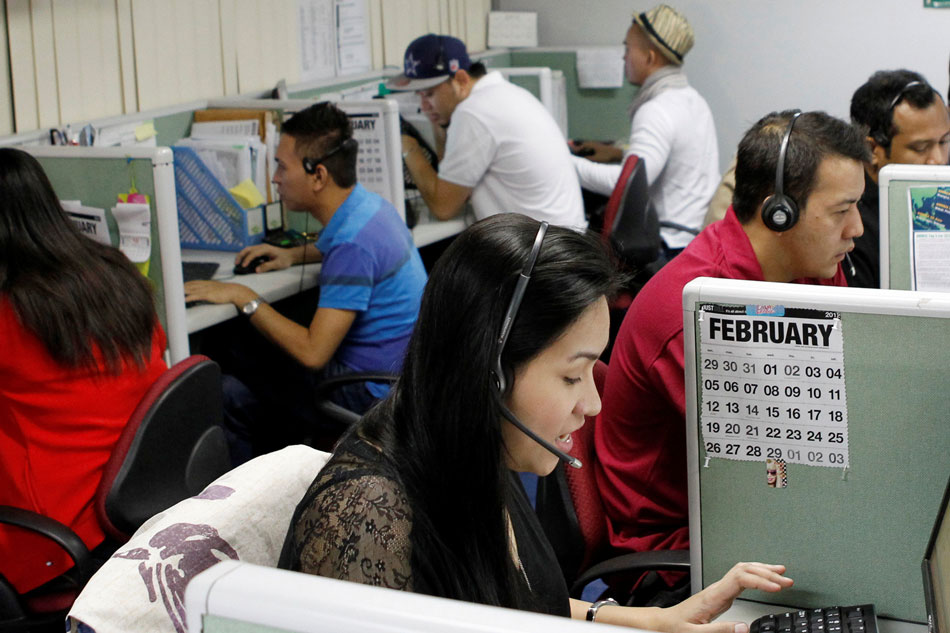
Business process outsourcing is an economic lifeline in the Philippines with over 1.15 million Filipinos working in the industry. File photo

MANILA - The Philippines is the second top globalization destination in the world this year, according to global strategic advisory firm Tholons.

The 2018 Services Globalization Index saw the Philippines rising to the second spot of the "Top 50 Digital Nations" after placing third last year.

India continues to dominate the list while Brazil follows the Philippines at third place.

Other countries in the top 10 are the United States, Mexico, Canada, Russia, Vietnam, Colombia, and South Africa.

"Most of the services will get commoditized for the biggest leaders in services globalization like US, UK, Canada, Europe, India, Philippines, East Europe, and Latin America," the index report stated.

Business process outsourcing is an economic lifeline in the Philippines with over 1.15 million Filipinos working in the industry.

The industry, along with remittances from overseas workers, remains one of the top 2 earners of foreign exchange for the Philippines.

SUPER CITIES

Six cities from the Philippines, meanwhile, made it to the "Top 100 Super Cities," with Manila placing second to Bengaluru in India.

The Philippine capital, which ranked fourth in 2017, is followed by the Indian city of Mumbai, which ranked third.

The rest of the Philippine cities included in the list all saw an improvement in their respective rankings.

Close to the top 10 is Cebu City, which ranked 11th from 12th last year, while President Rodrigo Duterte's hometown Davao City went 10 notches higher to the 75th spot from 85th last year.

Santa Rosa City in Laguna rose to the 87th spot from 100th last year while Bacolod City climbed to the 89th spot from 97th in 2017.

The Visayan city of Iloilo, meanwhile, is a newcomer to the list, landing at the 92nd spot.

The index evaluates and ranks countries and cities based on availability and quality of talent in the area, business catalyst or the level of industry-related activity and organizational support, cost of doing business, infrastructure, innovation, and risk and quality of life among others.


Pinoy farmer finalist in International Cocoa Awards

Filipino farmer makes it to the finals of 2019 International Cocoa Awards Antonio Colina Manila Bulletin 18 August 2019 DAVAO CITY ...