Showing posts with label list. Show all posts

Friday, July 26, 2019

PH rank in Innovation 2019

Philippines break into the ranks of innovation achievers - report

Dennis Valdez
BusinessWorld
26 July 2019


THE PHILIPPINES has moved up 19 spots to 54th out of 129 economies from last year on an annual list that tracks their performance in terms of innovation, with the country breaking into the ranks of 17 others that “outperform” in this regard relative to gross domestic product.


The Global Innovation Index 2019 (GII) — prepared by Cornell University, INSEAD and the World Intellectual Property Organization — said the Philippines improved in almost all the metrics which the report used, namely: in Institutions, Human Capital and Research, Infrastructure, Business Sophistication, Knowledge and Technology Outputs and Creative Outputs.

“In the Business sophistication (32nd) pillar, the Philippines improves in almost all the indicators related to Innovation linkages and gains top ranks in High-tech imports (5th) and Research talent (6th),” the report read.
“In Knowledge and technology outputs (31st), the data for indicator High-tech net exports became available this year and the country ranks 1st,” it added.
“Four other indicators rank in the top 10: Firms offering formal training (9th), productivity growth (10th), ICT services exports (8th), and Creative goods exports (8th).”
At the same time, the Philippines was found weak in terms of ease of starting a business, ease of getting credit, expenditure on education, global R&D companies, scientific and technical articles and new businesses.
“While some changes to the GII model explain a small part of this leap, newly available metrics give a more thorough assessment of the country’s innovation performance, which itself shows some signs of progress,” the report said of the Philippines’ performance this year.
Compared to its regional peers, the report said the Philippines showed “relatively good scores” particularly in trademarks, females employed with advanced degrees, high-tech imports and creative goods exports.
The report noted that, on the whole, the country was one of the most improved on this year’s list, propelling it to break into the “innovation achievers” cluster.
“The Philippines appears for the first time in the group of innovation achievers. It scores above average in all innovation dimensions, with the exception of Market sophistication, relative to its lower middle-income peers,” the report said.
“It has remarkable performance in Knowledge diffusion and Knowledge absorption, not only relative to its income group and geographic region, but also relative to all other economies assessed in the GII.”
Reacting to the report, Trade Secretary Ramon M. Lopez said in a statement: “This is great news for our nation and our innovation ecosystem as a whole. It recognizes the efforts of the various government agencies… in advancing innovation among our people and MSMEs (micro, small, medium enterprises), creating an innovative culture, as well as in building linkages with academe and industry.”
He added that he expects further improvement in the country’s rank after the recent signing of Republic Act (RA) No. 11293 or the Philippine Innovation Act and RA No. 11337 or the Innovative Startup Act.
MalacaƱang also welcomed results of the latest report, saying in a statement that it commends the departments and agencies that helped achieve the improvement in the country’s global rank. “May this good news further motivate them in creating an environment that nurtures innovation and creates business opportunities as we become one of the fastest growing economies in the globe,” Presidential Spokesperson Salvador S. Panelo was quoted as saying.
The global top 10 consist of, in descending order: Switzerland (also top last year), Sweden (from 3rd), the United States (from 6th), the Netherlands (from 2nd), the United Kingdom (from 4th), Finland (from 7th), Denmark (from 8th), Singapore (8th from 5th), Germany (flat from 9th last year) and Israel (from 11th).
Seven of the 15 economies in the South East Asia, East Asia and Oceania group rank in the top 25, namely: Singapore, South Korea (11th), Hong Kong (13th), China (14th), Japan (15th), Australia (22nd) and New Zealand (25th).
Besides Singapore (8th) and the Philippines (54th), the other Southeast Asian countries on the list performed as follows: Malaysia (35th), Vietnam (42nd), Thailand (43rd), Brunei (71st), Indonesia (85th) and Cambodia (98th).
India, to which the Philippines is frequently compared when it comes to business process outsourcing, placed 52nd in this year’s report. — Denise A. Valdez

Thursday, June 20, 2019

PH universities in world ranking

4 Philippine universities among world’s top 1000


Marjaleen Ramos
Manila Bulletin
20 June 2019

Four universities in the Philippines made it to the QS World University Rankings 2020.
The rankings, released on Wednesday, showed that University of the Philippines (UP), the country’s flagship state university, moved up from 384th last year to 356th.
University of the Philippines Diliman | Photo courtesy of Wikimedia Commons
356. University of the Philippines 
Ateneo de Manila University (ADMU) ranked to 601-650th spot from 651-700th last year.
Related image
601-650. Ateneo de Manila University
 De La Salle University (DLSU) and University of Santo Tomas (UST) both retained their 801-1000th spots.
801-1000. De la Salle University


801-1000. University of Sto. Tomas


The QS ranks the top 1,000 universities in the world according to academic reputation, employer reputation, faculty/student ratio, citations per faculty, international faculty ratio, and international student ratio.
The top five in the list were Massachusetts Institute of Technology, Stanford University, Harvard University, California Institute of Technology, University of Oxford and University of Chicago.
In Asia, the top school was Nanyang Technological University (NTU) in Singapore, which beat out the National University of Singapore (NUS) which dropped to second place.
Tsinghua University was third, Peking University fourth and University of Tokyo fifth.

Thursday, December 6, 2018

Asia's Best Beaches

Palawan beach tops ‘Asia’s Top 50 Beaches’ list, ranks 3rd best beach worldwide

Deni Rose M. Afinidad-Bernardo 
Philippine Star
06 December 2018


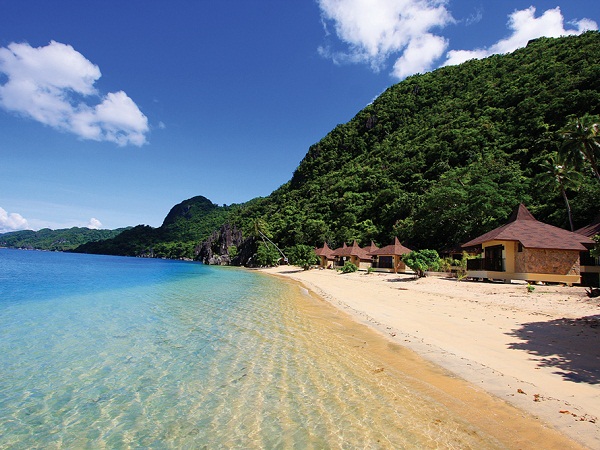
PALAWAN, Philippines — For its protruding limestone cliffs “shooting out of the turquoise-blue lagoon straight to the sky,” Hidden Beach in El Nido, Palawan has been voted as the number one beach in Asia and the third best beach in the world by over 1,000 journalists, editors, travel bloggers and agencies that reportedly participated in a recently completed survey.

Hidden beach, El Nido.Credit: sonny-sails.com

According to the poll conducted by Canada-based online travel company Flight Network, Hidden Beach is the only Philippine beach that made it to the survey’s World’s Top 50 Beaches list voted by travel experts and enthusiasts, reportedly including journalists and editors from Lonely Planet, Forbes, Daily Mail, BBC News, LA Times, Conde Nast Traveler, and National Geographic Traveler.
“Flight Network consulted these travel professionals to rank the best beaches in the world, based on their personal and professional experiences. We received unparalleled insight into the most spectacular beaches on earth,” the online travel company said in its website.

The company has listed on its website the names and social media accounts of everyone who allegedly participated in its survey, including at least one Filipino travel blogger and a Philippine Airlines representative.

Upon completion of the voting process, the network’s in-house travel experts analyzed and categorized the results.

“We created several official lists, including the top 50 beaches around the globe, as well as separate lists showcasing the top 50 beaches in several regions of the world, such as Africa, North America, South America, Central America and the Caribbean, Australia and the South Pacific and Asia. Even further, we ranked the top 50 beaches within or near cities and the top 50 most remote, or untouched, beaches.”

Based on the poll results, El Nido’s Hidden Beach has been ranked as the best beach in Asia for 2018 as this “tropical, white sand, postcard-perfect beach” has “unmistakable” limestone cliffs “that draw your eyes away from the magnificent reefs and palm-lined shores.”

“The wild, vegetation-covered rock formations and crystal clear waters of Hidden Beach will make you feel as if you’ve been dropped into a movie,” said one of the poll’s participants, Sachin Aggarwal of Carlson Wagonlit Travel.

“Until somewhat recently, the only ones flocking to the remote El Nido island were the swiftlets who nest in the cliffs — hence the name El Nido, which means beach in Spanish. Now, all those who visit enjoy breathtaking views and world-class diving by day and luxurious resorts by night,” a description of the beach’s location said in the website.

Apart from Hidden Beach, other Philippine beaches included in ‘Asia’s Top 50 Beaches’ list include:


  • Guyam White Sand Beach in Siargao at no. 13
Palaui Island Beach. Credit: Cuervopropertyadvisory.files.wordpress.com

  • Palaui Beach in Cagayan Valley at no. 22 
Caramoan. Photo grab from Inquirer.net

  • Caramoan in Camarines Sur at no. 29
Credit: davaocitybybattad.blogpot.com

  • Dahican Beach in Mati, Davao Oriental at no.  41
Gumasa Beach at Noon
Credit: gensanportal.com

  • Gumasa Beach in Sarangani at no. 45
Villa Kasadya | Panglao Bohol
Credit: villakasadya.com

  • Alona Beach, Panglao, Bohol at no. 46
Credit: Philippine lifestyle.com

  • Kalanggaman Island, Leyte at no. 49
Credit: Siquijor-island.com

  • Paliton Beach, Siquijor at no. 50
According to the network, the globally-recognized list aims to showcase a collection of off-the-beaten-path slices of paradise from every corner of the planet.

Wednesday, November 28, 2018

Asia-Pacific's Most Optimistic Workers

LinkedIn: Filipinos among most confident in Asia-Pacific on opportunities to get ahead 

Manila Standard
28 November 2018


LinkedIn, the world’s largest professional network, has just revealed its inaugural LinkedIn Opportunity Index in the Asia Pacific region where it has more than 153 million members including six million in the Philippines.

The Index is a composite measure that seeks to understand how people perceive opportunity and more importantly, barriers that may prevent them from getting to those opportunities. The research surveyed over 11,000 respondents in nine markets in the Asia Pacific region - Australia, Chinese Mainland, Hong Kong, India, Indonesia, Japan, Malaysia, the Philippines, and Singapore.
The Philippines ranked third along with the Chinese Mainland on the LinkedIn Opportunity Index, with Indonesia and India taking the top two spots.
On the other hand, more developed markets such as Japan, Hong Kong, and Australia trailed in the Index as people in these markets expressed concerns over the economic outlook, and generally felt more cautious about their chances of accessing and achieving success with opportunities that are relevant to them.
“We believe access to opportunity should be universal and for everyone. With the inaugural LinkedIn Opportunity Index, our aim is to gain an insight into the aspirations of people across the Asia Pacific region, how they feel about the opportunities they want to pursue, as well as the barriers that may stand in their way. The growing workforce in the region is a key asset that, if harnessed effectively, is going to continue to drive the economies. Over time, by tracking people’s perception of opportunity and the barriers they face, we hope we can continue to facilitate more of a balance between demand and supply in the opportunity marketplace,” said Olivier Legrand, Managing Director, LinkedIn in Asia Pacific.
Key Highlights of LinkedIn Opportunity Index 2018:
- Starting own business is top opportunity for respondents in the Philippines
More than half, or 53 percent, of respondents in the Philippines see “starting my own business” as their definition of opportunity. They are similar to respondents in Indonesia (50%) who are interested in entrepreneurial pursuits. In contrast, respondents in Australia (13%), Hong Kong (13%) and Japan (7%) are least likely to embark on new ventures.
Similar to many respondents in APAC, many respondents in the Philippines hope to achieve or maintain work-life balance. A significant 44 percent of respondents in the country have identified “having a job which offers good work-life balance” as their ultimate definition of opportunity, slightly above the APAC average of 40 percent.

A significant 37 percent of respondents in the Philippines also interpret their ultimate opportunity as being able to learn a new skill. In an environment concerned with the impact of AI/automation and other shifts in the labour ecosystem, professionals also recognise that with jobs rapidly evolving, they need to upskill to stay relevant.
- Respondents in the Philippines cite financial status as top barrier to opportunity
Similar to the rest of APAC, a significant number of respondents in Philippines (46 percent) believe that their less optimal financial situation is the top obstacle to their access to opportunity.
While APAC respondents cited barriers to opportunity such as lack of a strong network and connections, a difficult job market, and lack of required professional skills, respondents in the Philippines ranked innate or psychological reasons such as fear of failure (24 percent) and lack of confidence (20 percent) as bigger hurdles to overcome.
- The Philippines believes diligence is currency to get ahead in life
Similar to more than 90 percent of APAC respondents, 96 percent of respondents in the Philippines believe in working hard to get ahead in life. Other attributes respondents in the country consider as important to advance in life include the willingness to embrace change (93 percent), social equality (91 percent), level of education (87 percent), and knowing the right people or having the right connections (85 percent).
“The barriers to realising opportunities in life are very real, and despite the diversity of the Asia Pacific region, there are more similarities than differences when it comes to our hopes and aspirations. The good news is that no matter what opportunities mean for each one of us, we can count on our community for help. Whether it is learning a new skill, networking or sharing guidance, we can all help one another to unlock and create opportunities,” added Legrand.

Bloomberg's Top Emerging Markets

Malaysia remains on top of emerging markets list

The Star Online
28 November 2018

Four of the top six economies on the scorecard are from Asia, including China, the Philippines and Thailand.


Malaysia remained at the top of the emerging-market list, thanks to its current-account surplus, relatively stable economic growth outlook and valuations.


KUALA LUMPUR: Malaysia remained at the top of the emerging-market list, thanks to its current-account surplus, relatively stable economic growth outlook and valuations.

According to a Bloomberg analysis on Wednesday, data last week showed inflation came in at 0.6% in October from a year earlier, compared with its 10-year government bond yield of about 4.17%.


The scorecard includes metrics ranging from growth prospects to the state of the current account, sovereign credit ratings and stock and bond valuations.

Bloomberg reported Asia’s economies have stronger buffers against headwinds like Federal Reserve policy tightening and outshone the rest of the emerging markets, Malaysia holding on to the No. 1 spot.


However, Turkey has tumbled to bottom of the pile. Ranked fifth out of 21 nations in a similar study six months ago.

Turkey’s economy is forecast to grow 0.8% in 2019, down from an estimated 3.5% this year, according to a Bloomberg survey of economists. Inflation reached 25.2% in October, the highest level since 2003, eroding real yields

Four of the top six economies on the scorecard are from Asia, including China, the Philippines and Thailand.

China and Thailand are drawing support from current-account surpluses, relatively strong growth and benign inflation. The Philippines’ current-account deficit and high inflation rates are partly
offset by growth of more than 6%.

“A closer attention is now paid to economic growth outlooks of each emerging economy amid successive rate hikes,” said Tsutomu Soma, general manager of the investment trust and fixed-income department at SBI Securities Co. in Tokyo.

“Investors are also deciphering how each country is impacted by the U.S.-China trade frictions. They will continue to be more selective with their investments given such circumstances.”

Selected economies are either in the MSCI Emerging Markets Index or a Bloomberg Barclays measure tracking EM local-currency government bonds.

Valuations are computed based on real yields, price-to-earnings ratios for MSCI’s equity gauges and real effective exchange rates.

The numbers are Z-scores that measure deviations from the average of the economies covered in the case of GDP, current-account balances, ratings and real yields. The Z-scores for real effective exchange rates and P/E are based on historical comparisons.

For reserves, the economies that sufficiently meet the International Monetary Fund’s adequacy ratio get a zero score and those that fall short receive minus 1.

GDP growth and current account balances are from economist forecasts for 2018 and 2019 compiled by Bloomberg. Sovereign ratings are from S&P Global Ratings. Real effective exchange
rates are based on JPMorgan Chase & Co. data. - Bloomberg


Saturday, October 20, 2018

Top Globalization Destination

Philippines is world's second top globalization destination: index

Arianne Merez
Abs-CBN News
20 Oct 2018

Business process outsourcing is an economic lifeline in the Philippines with over 1.15 million Filipinos working in the industry. File photo

MANILA - The Philippines is the second top globalization destination in the world this year, according to global strategic advisory firm Tholons.

The 2018 Services Globalization Index saw the Philippines rising to the second spot of the "Top 50 Digital Nations" after placing third last year.

India continues to dominate the list while Brazil follows the Philippines at third place.

Other countries in the top 10 are the United States, Mexico, Canada, Russia, Vietnam, Colombia, and South Africa.

"Most of the services will get commoditized for the biggest leaders in services globalization like US, UK, Canada, Europe, India, Philippines, East Europe, and Latin America," the index report stated.

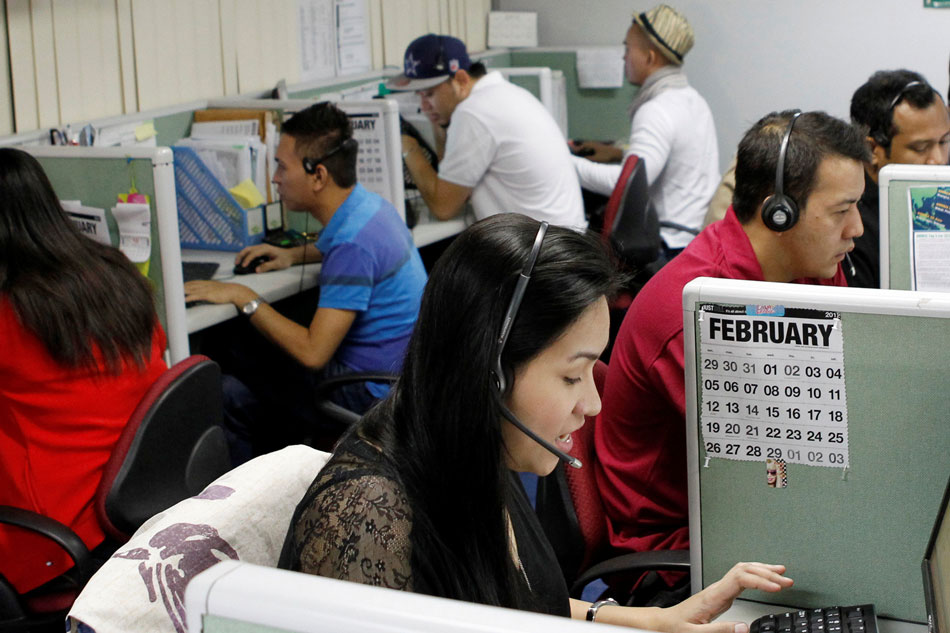
Business process outsourcing is an economic lifeline in the Philippines with over 1.15 million Filipinos working in the industry.

The industry, along with remittances from overseas workers, remains one of the top 2 earners of foreign exchange for the Philippines.

SUPER CITIES

Six cities from the Philippines, meanwhile, made it to the "Top 100 Super Cities," with Manila placing second to Bengaluru in India.

The Philippine capital, which ranked fourth in 2017, is followed by the Indian city of Mumbai, which ranked third.

The rest of the Philippine cities included in the list all saw an improvement in their respective rankings.

Close to the top 10 is Cebu City, which ranked 11th from 12th last year, while President Rodrigo Duterte's hometown Davao City went 10 notches higher to the 75th spot from 85th last year.

Santa Rosa City in Laguna rose to the 87th spot from 100th last year while Bacolod City climbed to the 89th spot from 97th in 2017.

The Visayan city of Iloilo, meanwhile, is a newcomer to the list, landing at the 92nd spot.

The index evaluates and ranks countries and cities based on availability and quality of talent in the area, business catalyst or the level of industry-related activity and organizational support, cost of doing business, infrastructure, innovation, and risk and quality of life among others.


Wednesday, October 17, 2018

WEF Philippine Ranking 2018


Philippines and India rise in global competitiveness

World Economic Forum evaluates improvements in infrastructure and innovation

The Philippines moved up 12 rungs to 56th place in World Economic Forum's The Global Competitiveness Index 4.0.    © Reuters

TOKYO -- The World Economic Forum's latest global competitiveness list shows a positive picture in Asia, with the Philippines and India moving up the ranks.

The Global Competitiveness Report 2018, published on Wednesday, showed the Philippines rising 12 rungs from last year to 56th of a total of 140 countries and regions, based on a new methodology applied to both years. India also rose five places to 58th, making the largest gain among G-20 economies.

WEF used a new methodology in its latest edition to include elements that determine productivity. Of the 98 indicators, 34 were retained from the previous methodology while the other 64 indicators are new, resulting in new updated list for 2017.

Economic growth in the Philippines exceeded 6%, along with China, Cambodia and two other countries in Southeast Asia. The WEF also noted that the country's safety improved over the year, with scores in indicators including organized crime, homicide rate and incidence of corruption rising.

It ranked 21st in social capital.

The country's infrastructure such as airport and shipping connectivity improved as well. On the other hand, the Philippines still needs to enhance education, its product market as well as its workforce, the report shows.


India was ranked 8th in "quality of research institutions." The Geneva-based WEF highly evaluates the country noting "a remarkable example of a country that has been able to accelerate on the pathway to innovation, due, particularly, to the quality of its research institutions."

The ease of doing business in India has also improved. The cost of starting a business has come down and time to start a business has shortened over the year. The report expects further improvements in India's health sector which ranks 108th and skills sector which stands at 96th.

Singapore topped the Asian chart and was second globally behind the U.S. The report says the "openness [of the city-state] is the defining feature of this global trading hub and one of the main drivers of its economic success." Its infrastructure, health and product markets also topped the ranks.

Japan rose three places to 5th. It is the most improved of the top 10 countries and regions, ranking first in health, digital and physical infrastructures.


Japan is one of the region's key innovation hubs along with South Korea and Taiwan. However, the report said they "could improve on the so-called 'softer' drivers of innovation to attain the level of 'super innovators,'" such as Germany, the U.S. and Switzerland, as Japan scores fairly low on risk aversion, meaning not taking enough risks, and critical thinking. Japan has also room to improve its levels of social capital and corporate governance.

China kept its ranking at 28th, Hong Kong came in 7th overall and third in Asia. It is comparable to Singapore but the report noted that it scored "slightly less well in terms of innovation and labor market efficiency." Its sea port infrastructure and connectivity ranked first, while ICT adoption and financial system had high scores as well.

Taiwan also remained in the same ranks at 13th, while its macroeconomic stability scored it at 100. Its innovation capability was at 4th place, with abundant international co-inventions and cluster development.


South Korea rose up to 15th place, up two rungs compared with the 2017 edition, thanks to its leading position in ICT adoption. Its R & D expenditure is the second highest after Israel, at the equivalent of 4.2% of its gross domestic product. The report suggests the country can improve in entrepreneurial risk-taking and employee empowerment.

Malaysia, Thailand and Indonesia all rose in their ranks but Vietnam fell three places to 77th.

Pinoy farmer finalist in International Cocoa Awards

Filipino farmer makes it to the finals of 2019 International Cocoa Awards Antonio Colina Manila Bulletin 18 August 2019 DAVAO CITY ...