Showing posts with label infrastructure. Show all posts

Wednesday, July 31, 2019

PH new Manila international airport

Philippines approves plan to build new Manila airport


Gulf News| 31 July 2019

Philippine conglomerate San Miguel will build the airport in Bulacan town
airport generic

Highlights


  • San Miguel Corp was the only company to bid for the project
  • Company will have to break ground on the $14 billion project before the end of the year
  • It is set to open for business no later than 2025 

MANILA: The Philippines on Wednesday approved a plan to build a new airport near Manila, in a bid to ease congestion with the capital's existing airport operating at full capacity.

Philippine conglomerate San Miguel will build the airport in Bulakan town, north of Manila Bay, that will feature four parallel runways and serve 100-200 million passengers a year, a government statement said.
"This new international airport is important in helping ease the congestion of the Ninoy Aquino International Airport (in Manila)," Transportation Secretary Arthur Tugade said in the statement.

San Miguel, which was the only company to bid for the project, will have to break ground on the $14 billion project before the end of the year and open for business no later than 2025, the statement said.


The company has said it plans to run the airport — which would be the biggest infrastructure project under President Rodrigo Duterte's government, after obtaining a government concession.

The existing Manila airport, which has two runways, handled nearly 260,000 flights and served 45 million passengers last year, according to its website.

The announcement came after the close of trade in Manila. Shares in San Miguel rose 1.19 percent to end at 178.00 pesos ($3.50).

Sunday, April 28, 2019

Billion Dollars Chinese investment in PH

Philippines gets $12.2B in new investments, trade commitments from China


Doris Dumlao-Abadilla
Philippine Daily Inquirer
28 April 2019


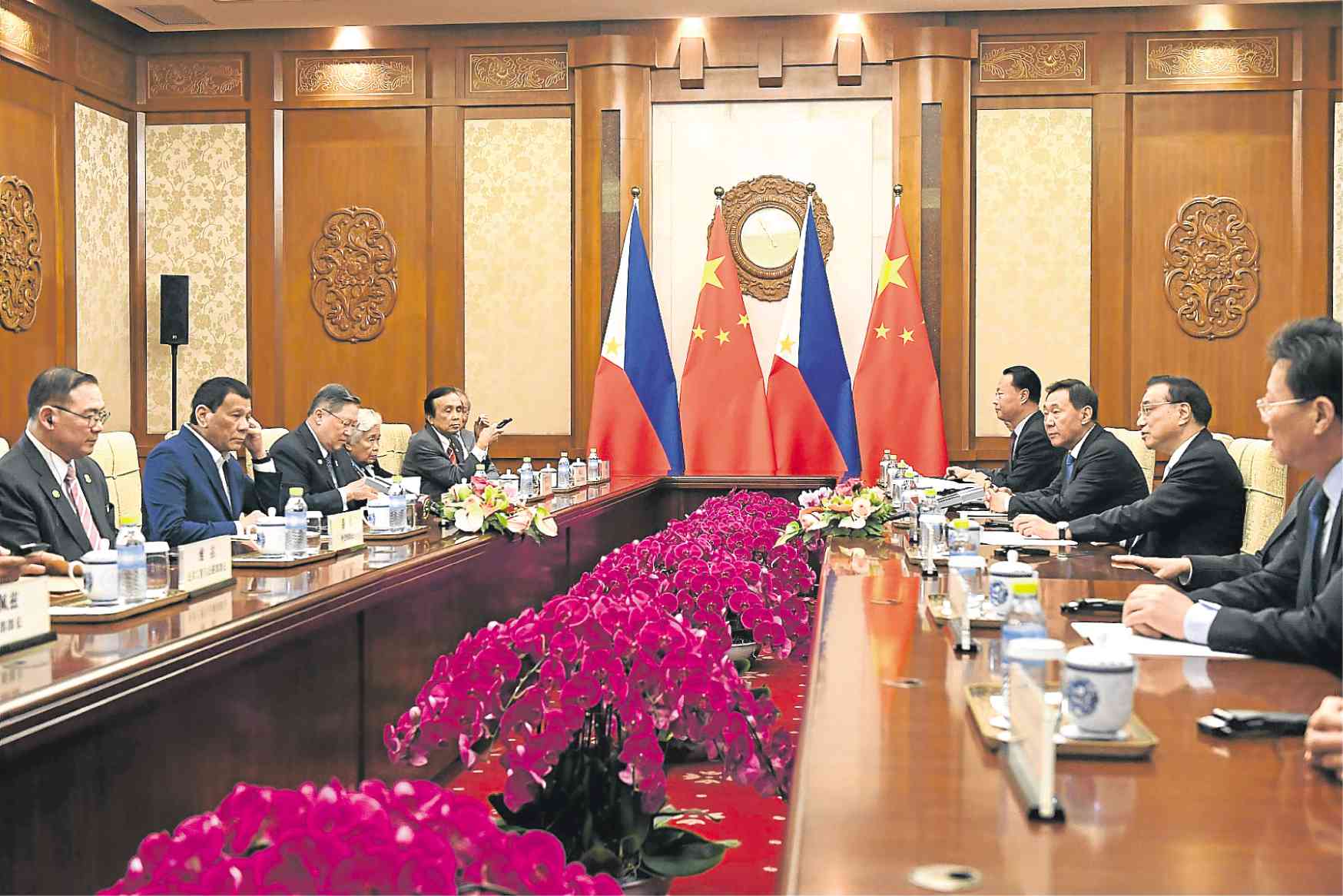
BEIJING—The Philippines bagged $12.16 billion worth of new investment and trade deals with Chinese partners—including big-ticket and labor-intensive energy, petrochemical, industrial park and infrastructure projects—on the sidelines of President Duterte’s visit to China.


FRESH AGREEMENT President Duterte (second from left) meets with Chinese Premier Li Keqiang (second from right) at the Diaoyutai State Guesthouse in Beijing on Friday. —AFP
Duterte witnessed on Friday the signing of 19 business agreements, which are expected to create more than 21,165 new jobs in the Philippines, Trade Secretary Ramon Lopez said.

The President guaranteed to the Chinese businessmen that he would crack down on corruption and ease doing business in the Philippines.


Biggest winner


Among the biggest winners during this trip is Filipino conglomerate Tranzen Group of mining mogul Salvador Zamora II. Tranzen signed a framework agreement with China Power Investment Holding for thermal, hydroelectric and renewable power plants cumulatively valued at around $1.5 billion to $2 billion. These are expected to create 1,000 jobs.


Tranzen likewise signed two memorandums of understanding (MOU) for infrastructure and telecommunications projects. One was with China Harbour Engineering Co. Ltd. for the construction of a Light Railway Transit in Manila, housing and roads in North Luzon.


These projects have a combined value of $4 billion and are expected to generate 1,000 jobs.


The Davao Occidental provincial government and Fengyuan Holdings also signed an MOU for a $1.5-billion petrochemical refinery processing plant complex to be located at the Tubalan Cove Business and Industrial Park. This could employ some 500 workers.


Pampanga project


The Pampanga provincial government and Chinese company Macrolink Group likewise inked a $1.5-billion framework agreement to construct and develop the Yatai Industrial Park, which would create an estimated 10,000 jobs.

In all, the Philippines signed one contract agreement, three cooperation agreements, two purchase framework agreements and 13 MOUs and memorandums of agreements with Chinese companies.


Outside of the new deals, electronics manufacturer AAC Technologies disclosed plans to expand its operations in the Philippines during a courtesy call on Lopez by its officials.


AAC had set up shop at Gateway Business Park in General Trias, Cavite, taking over a Korean company in 2014. It committed to invest $30 million to manufacture stepper motors and motor reducers, creating about 3,000 jobs in the next three years.


A contract agreement was signed for the proposed 250-megawatt South Pulangi Hydroelectric Power Plant Project in Damulog, Bukidnon.


To be developed by Pulangi Hydro Power Corp. and China Energy Co Ltd., this $800-million project aims to improve power supply reliability and resilience, particularly in Mindanao. About 5,000 jobs would be created by the project.

Wi-Fi connectivity


As part of a long-term plan to reduce dependence on imported fuels, the Department of Energy, Shanghai Electric Group Co. Ltd. and Deluxe Family Co. Ltd signed a $40-million MOU to collaborate on the promotion of indigenous, new and renewable energy resources.


Another telecommunication deal involved CITIC Guoan Information Technology, which signed a $500-million project to construct infrastructure for nationwide Wi-Fi internet connectivity in various capital cities and towns in the Philippines. This project is expected to create 1,000 jobs.


Two Philippine companies signed purchase framework agreements to supply agricultural products to Chinese companies. Philpack Corp. bagged a deal to supply $40 million worth of pineapples to Chinese company Goodfarmer Foods Holding Group, while Eng Seng Food Products was tapped to supply $36.5 million worth of green coconuts to China Artex Corp. The latter is expected to create 1,500 jobs.

Infrastructure funding


The Cagayan Economic Zone Authority (Ceza) signed six MOUs with Chinese companies to develop its economic zone. The projects include a $150-million yacht club, a $500-million green textile industry park, a $500-million expansion of the Cagayan North International Airport, a $100-million financial technology hub and financial center, a $500-million smart city, and $150 million for various projects, including a resort and theme park, and a lithium battery manufacturing plant.

A framework agreement was signed between GFTG Property Holdings and Sanya CEDF Sino-Philippine Investment Corp. for a $298-million project to develop Grande and Chiquita Islands under the Subic Bay Metropolitan Authority. The project is set to create 500 to 1,000 jobs.


Adnama Mining Resource Inc., Fu Properties Inc, and Xiamen C&D Inc. also signed an MOU to construct a $50-million iron processing plant in Agusan del Norte.


Since rekindling diplomatic ties with China in 2016 after Duterte took office, the Philippines has attracted big-ticket infrastructure funding from China.


Based on various published reports prior to the President’s latest trip to China, the Chinese government and private companies have made more than $34.24 billion in investments, loans, aid and trade commitments to the Philippines from 2016 to 2018.


Among the most prominent China-funded projects are the Kaliwa Dam project (P12.2 billion or $234 million), Chico River Pump Irrigation Project (P4.37 billion), Mindanao Railway project (P128.1 billion), Binondo-Intramuros bridge (P4.61 billion) and Estrella-Pantaleon bridge (P1.37 billion or $26.3 million).


Redefine cooperation


In a speech at the Forum on Friday,  Duterte urged fellow world leaders to redefine international cooperation to ensure that development assistance would not promote dependence but instead trigger sustainable growth anchored on mutual respect and mutual interests.


“Development assistance should build on capacities of nations. It should never foster dependence,” he said.


“It should be based on reciprocal benefits, motivated by keen interest in partner states to bring about real progress. This should be the new normal. And it is in our interest to work together to make this a reality,” he added. —WITH A REPORT FROM INQUIRER RESEARCH

Friday, November 23, 2018

Philippines and Japan Infrastructure Partnership

Philippines, Japan line up more 
projects for funding

BusinessWorld
23 November 2018

PNR
BW FILE PHOTO


MORE INFRASTRUCTURE projects funded by Japan advanced further in the pipeline after top economic officials from the Philippines and Japan exchanged notes during their meeting late Wednesday, while also identifying new prospects.
Philippine and Japanese officials held the 6th meeting of the Philippines-Japan High-Level Joint Committee on Infrastructure Development and Economic Cooperation in Manila on Wednesday evening where both sides signed and exchanged notes for a ¥37.905-billion, or $336.24 million, loan for the Pasig-Marikina River Channel Improvement Project Phase IV and another ¥167.199 billion, or $1.413 billion, for the first tranche of the North-South Commuter Railway (NSCR) Extension Project.
The Pasig-Marikina River Channel Improvement Project involves upgrading works along the stretch of the Upper Marikina River — from downstream of the Manggahan Floodway to the Marikina Bridge — as well as construction of the Marikina Control Gate Structure.
The 109-kilometer NSCR Extension Project, meanwhile, will extend the Malolos, Bulacan-Tutuban, Manila railway to Clark International Airport in the north and to Calamba, Laguna in the south. The system will have 58 eight-car trains, seven of which will be airport express trains, and a double-tracked elevated railway that will connect with other lines in Metro Manila.
The exchange of notes is done before the signing of loan agreements.
Manila and Tokyo also signed and exchanged bilateral documents for a Contract of General Consulting Service for the Metro Manila Subway Project Phase I between the Department of Transportation (DoTr) and a consortium of six Japanese firms and OC Global; and the joint venture agreement among the Bases Conversion and Development Authority (BCDA), Japan Overseas Infrastructure Investment Corporation for Transport and Urban Development (JOIN), and Surbana Jurong for the New Clark City.
Both sides committed to open the first three stations of the Metro Manila Subway by May 2022, inclusion of the Ninoy Aquino International Airport line extension in the detailed engineering design of the project and establishment of the Philippine Railway Institute by 2021.
Finance Secretary Carlos G. Dominguez III said in a briefing after the meeting that technical working groups will meet regularly to “address challenges for the railway projects.”
“The Japanese side requested the Philippine government to expedite measures such as land acquisition and relocation of utilities.”
Both sides also discussed the possibility of more Japanese ODA financing for “road construction and expansion projects in northern Luzon and Metro Manila, flood management and drainage improvements, and various components of the New Clark City project.”
Loan agreements signed by Japan and the Philippines since the committee met in March last year include: P11 billion for the Mega Manila Subway; P18.76 billion for the Metro Rail Transit-Line 3 (MRT-3) Rehabilitation program, P2.10 billion for the New Bohol Airport Construction and Sustainable Environmental Protection Project Phase 2, and the P4 billion for the Arterial Road Bypass Phase 3 project.
“The Philippines is already at the verge of graduating to the level where we will not qualify anymore for ODA for some countries. Our income per capita is rising, so while we are still here, I think it is best for us to take advantage of the long tenors and the relatively low interest rates because after a few years we will no longer be qualified for that. We will be considered a middle-income country, therefore, we will have to pay higher interest rates. So it makes sense for as to have these projects funded now rather than later,” Mr. Dominguez said.
Aside from Japan, the Philippines has attracted financing support from China, South Korea, Australia, New Zealand, Spain, the United States, the European Union and Canada. — Elijah Joseph C. Tubayan

Thursday, September 27, 2018

The new Hong Kong

Manila rising as the ‘new Hong Kong’ 

Othel V. Campos
Manila Standard
September 27, 2017 

Manila is rapidly rising as a megacity powered by a growing pool of high-value talent, real estate expansion and a robust consumption-driven economy, property advisor Santos Knight Frank said Wednesday.


“Manila today is the Hong Kong and Singapore of 30 years ago. The level of development in the metropolis over the last decade has been unprecedented and reflects on the accelerated expansion of the property market. Manila has since become an important hub for industries such as IT-BPO [information technology-business process outsourcing] with huge opportunities of growth for other sectors,” said Santos Knight Frank chairman and chief executive Rick Santos.

He said with a population of more than 25 million people, the Greater Manila Area now had more people than Hong Kong and Singapore combined.
Its demographic is a high-value asset in industries such as IT-BPO, where Metro Manila ranks as fourth in the world based on the 2017 Tholons Services Globalization (Outsourcing) Index. 

Santos Knight Frank chairman Rick Santos discusses the property consulting company’s latest findings on the future trends in real estate in the global cities around the world during a news briefing and launching of Santos Knight Frank’s Global Cities Report 2018 at Makati Shangri-la Hotel. Lino Santos

A fast-growing metropolis, Metro Manila’s property market remains robust vis-à-vis several Asian cities. Prime office rents grew between 5 percent and 6 percent annually from 2011.
Prime office rents in Metro Manila increased 3.4 percent year-on-year in the second quarter, outperforming Tokyo at 3.2 percent; Taipei, 2.8 percent; Beijing, -1.9 percent; Shanghai, -2 percent; Singapore, -5.1 percent; and Jakarta, -8.3 percent.
Meanwhile, Metro Manila had one of the lowest vacancy rates at 3.4 percent across Asia Pacific in the second quarter.
“On a regional basis, the performance and fundamentals of the Manila office market look solid. While some of the other Southeast Asian markets are seeing demand remain sluggish and the major Chinese cities are seeing huge amounts of new supply, the Manila market has one of the tightest vacancy rates in the region and looks set for a strong 2018,” said Knight Frank Asia Pacific head of research Nicholas Holt.
The consulting firm said with a growing number of companies venturing onto the global stage, Metro Manila continued to see diversified demand, not only in the office market, but also in the residential sector, where investors from Southeast Asia, China and the Middle East were putting more capital into the Philippines.
“Over the next four years, Manila will see more than 3 million sqm of new office space added to the market. About 2 million sqm of residential space and half a million sqm more for retail will come online by 2019,” Santos said.
The government lined up 64 major infrastructure projects in the Philippines, several of which are underway in Metro Manila such as the NLEx-SLEx Connector Road, Naian Expressway Phase 2 and NLEx Harbor Link.
To decongest the metropolis and encourage development in the outskirts, important mass transport projects such as Mega Manila Subway, Manila-Clark Railway and expansion of the Light Rail Train are also in the pipeline.
“With limited supply of land in the city core, new districts have emerged in the outskirts of Metro Manila. The next wave of expansion is happening in emerging areas such as Alabang, Nuvali, Bulacan and Clark. It is crucial that infrastructure is in place to provide efficient connectivity between various parts of this growing city,” Santos said.

Pinoy farmer finalist in International Cocoa Awards

Filipino farmer makes it to the finals of 2019 International Cocoa Awards Antonio Colina Manila Bulletin 18 August 2019 DAVAO CITY ...