Showing posts with label President Duterte. Show all posts

Sunday, July 21, 2019

SONA 2019: Focus on Economy

Such great economic progress  in last 3 years  

   
Manila Bulletin |Editorial
21 July 2019

When President Duterte delivers his State of the Nation Address (SONA) at a joint session of Congress tomorrow, Monday,  it will mark the start of the second half of his administration.  A great deal is expected  in these next three years , especially in the economic  field. The World Bank  sees the Philippines as the fastest growing economy in the Association  of  Southeast Asian Nations (ASEAN) today. It is now  the  13th  largest economy in Asia, and  projected  to be the 5th largest  in Asia and 16th largest  in the world by 2050.
E CARTOON Feb 03, 2019
What could be the most significant economic development  for the country in the coming months and years  is  a joint  oil and gas exploration  with China which is expected to  begin this November, according to Energy Secretary Alfonso  Cusi,  chairman of the National Economic and Development Authority (NEDA).
President  Duterte  signed last May 28 Executive Order No. 80  removing a final roadblock to  an oil exploration, development, and production  agreement between the Philippine Exploration Corp. and the China National Offshore Oil Corp.  The  administration  had earlier signed  its first agreement with an Israeli company in 2018  covering a 416,000-hectare area east of Palawan. The  new agreement  with China covers a 720,000-hectare area in Calamian, west of Palawan. Calamian is one of two regions  near Palawan believed  to have considerable oil  resources;  the other is Reed Bank.
The  oil exploration agreement  is only one  area in  the multi-faceted relations  we have developed with China in the last three years. Our  trade with China, including Hong Kong, reached $417 billion this May, making  it the Philippines’ top trading partner. Philippine banana  exports tripled  in the first quarter of 2019 to $160 million.  Philippine  Online Gaming   Operations (POGO)  earned  P24 billion in taxes.  In 2018,  1.2 million Chinese tourists  boosted  the Philippine economy  by P32 billion;  2 million are expected  by 2020, a potential addition of  P50 billion to the economy.
In our ”Build, Build, Build”infrastructure program, China is involved in a big  way, including two donated bridges across the Pasig River, funding for a P500-million   Metro Manila flood-control project now on its second year,  a  P175-billion South Rail Project,  and  an P18.7-billion Kaliwa Dam to boost Metro Manila’s  water supply.
We may have ongoing  disputes in our conflicting claims to certain islands in the South China Sea, particularly in  the 200-mile  Exclusive Economic Zone we have renamed West Philippine Sea, but  President Duterte appears to have the situation well in hand.  He believes  the political  dispute will eventually be settled; in the meantime, he  is determined to see the Philippines benefit from the many  economic programs  that are underway.
The first half of the Duterte administration ends today  with considerable  economic  growth and progress. We look forward  to the second half which, we expect, will be marked with even more  economic  growth, as the President  spells out his plans for the country in the  next  three years in his State of the Nation Address tomorrow.

Saturday, July 6, 2019

PH among the best place to live

Duterte's Philippines Among The Best Places To Live And Work, Ahead Of China

Panos Mourdoukoutas| Forbes.com
06 July 2019

Philippines has been ranked 24th best place to live and work, just behind the US, which ranked 23rd, and ahead of China, which ranked 26th.

That’s according to the 2019 HSBC Expat’s annual survey, which is based on responses from more than 18,000 expats across 163 markets on three metrics: living, career opportunity, and family life.

The Philippines jumped up the rankings from 26th place last year.

That may come as a surprise to some for a couple of reasons. One of them is that the Philippines has a reputation for sending its own people overseas in droves rather than attracting foreigners who want to live and work there.


The other reason is that the country is mired in violence, which has taken a huge human toll.

Apparently, that isn’t what foreign expats are concerned about. They find it easy to relocate to a country of friendly people and a reasonable cost of living. “With its tropical climate and steadily growing economy, the Philippines is quickly becoming one of the most popular expat destinations in Southeast Asia, “ says the report.
Indeed, the Philippines economy has been booming in recent years. The Philippines’ per-capita GDP was last recorded at an all-time high of 3,063 U.S. dollars in 2018, according to Tradingeconomics.com. And it’s expected to reach $3,277 by 2020. That’s well above the average of $1,653.98 for the period 1960-2018.
Filipinos are doing better in recent years when per-capita GDP is adjusted by purchasing power parity (PPP). That measure, too, reached a record 7,599.19 U.S. dollars in 2018, well above the average of $4969.71 for the period 1990-2018.
Statistic 2015 2017 2018 2020 (projected)
Per Capita GDP $2615.7 $2891.36 $3,063 $3,277
Per Capita GDP PPP 6874.4 7599.19 7599.19 --
GDP Annual Growth Rate 6.5% 7.2% 5.60 --

Meanwhile, a recent McKinsey Global Institute (MGI) study places the Philippines among the few emerging market economies that are well-prepared to achieve sustained growth over the next decade.
That's thanks to a rise in gross fixed-capital formation (investment).
Still, the Philippines’ per-capita GDP is equivalent to 23% of the world's average, which makes Filipinos poor.
Meanwhile, the results of the expats survey should be interpreted with extreme caution. People surveyed are usually more affluent and better educated than the average immigrant, and they are on short assignments. This means that an overseas assignment may be seen as an “adventure.”
And the Philippines is a good place for that, better than China, as other surveys confirm.

Thursday, June 27, 2019

PH powerhouse economy

‘PHL growth faster than regional powerhouses’

Rea Cu| Business Mirror
27 June 2019

GROWTH of the Philippine economy will be faster than other regional economic powerhouses under the Duterte administration, the Department of Finance (DOF) said on Wednesday, citing the World Bank (WB) for such projection.

The country’s strong macroeconomic fundamentals provide the basis for the Bank’s expectations that the Philippine economy will grow faster than China and Malaysia, the DOF said in a statement on Wednesday.

Finance Undersecretary Gil S. Beltran said the World Bank based its projections on the Philippines’s solid external stance and “highly domestically driven” economy, which provides it “ample cushion” against external headwinds that are generally foreseen to slow down global growth this year.

“The Philippines is also expected to remain as an attractive destination for foreign direct investments [FDI]. We are pushing for further liberalization of investment ownership in the country,” said Beltran, also the chief economist of the DOF.

According to World Bank forecasts, the Philippines’s gross domestic product (GDP) is expected to grow by 6.4 percent this year, second only to Vietnam’s 6.6 percent, and higher than China’s 6.2 percent, Indonesia’s 5.2 percent and Malaysia’s 4.6 percent.

In 2020 and 2021, the Philippines’s GDP growth of 6.5 percent for both these periods will equal Vietnam’s 6.5 percent, also for both periods, and surpass China’s 6.1 and 6.0 percent, respectively.

The Indonesian economy is projected to expand 5.3 percent for 2020 and 2021, while Malaysia will maintain its growth at 4.6 percent in both these years.

Based on an economic research published by Standard & Poor’s (S&P) Global Ratings for June entitled Apac Monthly Snapshots: Trade Wars and Currency Corners, the country’s GDP is seen to settle between 6 percent and 6.5 percent this year.

“We continue to expect GDP growth to come in at the low end of the 6 percent to 6.5 percent range in 2019, with a likely resumption of the infrastructure build in the second half of the year to bring the fiscal impulse for the year to around neutral after being negative in the first half of the year. We also expect BSP [Bangko Sentral ng Pilipinas] to maintain its easing bias this year, supporting growth, as inflation will likely stay benign especially compared to last year’s spike,” the economic research said.

Beltran noted that the country’s debt-to-GDP ratio also continued its downward trajectory on the Duterte watch despite its ambitious infrastructure buildup under its “Build, Build, Build” (BBB) program, with national government debt in relation to GDP at 42.1 percent in 2017, and falling further to 41.9 percent in 2018.

“Moreover, the Philippines has implemented monetary and nonmonetary policies to keep inflation manageable and bring it back to the government’s target range of 2 to 4 percent this year. Perceived overheating risks have abated, driven by government measures and policies,” Beltran said.

Fitch Ratings has also maintained its “BBB” with a stable outlook for the Philippines as of May this year, while Moody’s also affirmed its Baa2 with a stable outlook as of November 2018.

Wednesday, April 10, 2019

PH economic boom

Economic Boom Lifts More People Out of Poverty in Philippines


The ranks of the poor in Philippines are moderating as the nation sustains among the fastest economic growth in the region.

A man teaches a dance lesson at the SM Mall of Asia complex in Pasay City, Metro Manila.
Photographer: Hannah Reyes Morales/Bloomberg 
Filipinos living below the poverty line were estimated at 21 percent of the population in the first half of 2018 compared with 27.6 percent in the same period in 2015, the Philippines Statistics Authority said in a report on Wednesday. The poverty incidence, based on a survey conducted every three years, eased even as inflation accelerated last year.

Poverty declined as infrastructure projects created new jobs and the state expanded its cash handouts. “Thanks to sustained economic growth and critical and broad-based reforms and investments that have translated to employment-generation and social protection,” according to Economic Planning Secretary Ernesto Pernia.
The Philippines is working to meet its target of reducing the poverty rate to at least 14 percent by the end of President Rodrigo Duterte’s term in 2022, his spokesman Salvador Panelo said. To meet that goal, at least a million Filipinos must be lifted from poverty each year. The nation can become an upper middle-income country this year, ahead of its 2022 target, Pernia said.

Highlights

  • The poverty threshold -- the minimum amount a family of five must have to meet basic food and non-food needs -- is pegged at 10,481 pesos ($201) a month in the first half of 2018. That’s 11 percent more than in the first half of 2015.
  • Filipino families with incomes below the poverty line were estimated at 16.1 percent in the first half of 2018 . That’s less than 22.2 percent in 2015.
  • Subsistence incidence or the ratio of Filipino families with incomes below the food threshold of 7,337 pesos a month was estimated at 6.2 percent. That compares with 9.9 percent in 2015.
  • Poverty incidence was highest in the Autonomous Region in Muslim Mindanao in the south and lowest in Metro Manila.

Get More

  • The International Monetary Fund forecasts that the Philippines will grow 6.5 percent this year and 6.6 percent in 2020.
  • Self-rated poverty rose in the third quarter of 2018 with more than half of Filipino families considering themselves poor, according to a Social Weather Stations poll.
— With assistance by Siegfrid Alegado, Claire Jiao, and Andreo Calonzo


Saturday, December 15, 2018

US War Loot Returns to Philippines

US returns looted Balangiga church bells to Philippines


BBC News | 15 December 2018
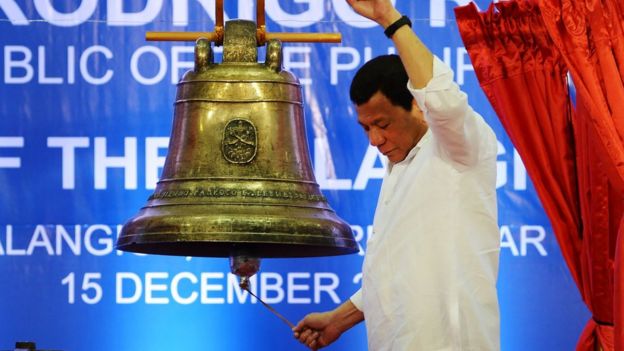
Three bells looted by US troops more than a century ago have been returned to their church in the Philippines.
President Rodrigo Duterte praised his countrymen and the US at a ceremony in Balangiga, where the treasures were taken 117 years ago.
The bronze bells were seized during the Philippine-American War as part of reprisals following a massacre.
In August, the US Embassy announced the return of the so-called Balangiga bells after decades of pressure.
"Nobody, but nobody, can claim a singular credit for the generous act of the Americans," Mr Duterte told a jubilant crowd on Saturday.
"The credit goes to the American people and to the Filipino people, period."
The president had called for their return in a 2017 speech, in which he also suggested building closer ties with China.

President Rodrigo Duterte rings one of the three Balangiga bells at a ceremony
President Duterte rang one of the bells at the ceremony on Saturday. AFP/Getty
The bells are viewed as a symbol of Philippine independence against their former colonial masters.
Following the Balangiga massacre of 1901, when Filipino militants ambushed and killed 48 US troops, US General Jacob H Smith ordered the area be turned into a "howling wilderness".
US troops seized the three bronze bells as war trophies during the bloody reprisals. Thousands of Filipinos are thought to have been killed.
Despite calls for their return for decades, US veterans and politicians said the bells were tributes to the killed US troops and refused to consider their repatriation.
One of the bells was with the US 9th Infantry Regiment in Korea and the other two were at a former 11th Infantry Regiment base in Wyoming.
But after continued Filipino pressure and waning opposition in the US, the bells were flown to Manila earlier this week for Saturday's ceremony in Balangiga.
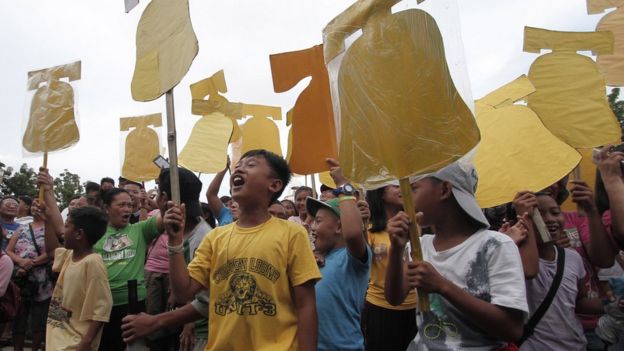
Crowds celebrate the return of the Balangiga bells to the Philippines
Filipinos waved bell-shaped placards ahead of the repatriation ceremony. EPA
"We are the happiest people on Earth now," 81-year-old Nemesio Duran told AFP news agency. "The whole town is walking in the clouds because the bells are finally with us."
However, for some the return struck a more sombre note.
Constancia Eleba told AFP the bells gave her "mixed emotions" given the history surrounding them.
"It was painful and you cannot take it away from us," she said. "We can never forget that."


Pinoy farmer finalist in International Cocoa Awards

Filipino farmer makes it to the finals of 2019 International Cocoa Awards Antonio Colina Manila Bulletin 18 August 2019 DAVAO CITY ...