Sunday, October 21, 2018

The Asia River Prize winner 2018


Manila's Pasig River wins International River Prize


Gilbert P. Felongco, Correspondent
Gulfnews.com
21 October 2018


Rehabilitation efforts pay off to bring back to life the once-dying water artery
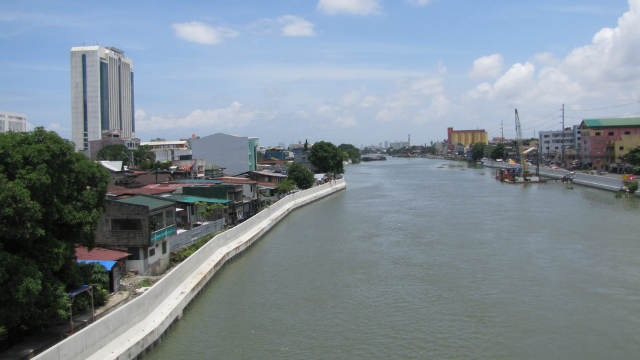
Image result for pasig river
PASIG RIVER. Picture: Spot.ph

Manila: A key river in the Philippines has won the inaugural 2018 Asia Riverprize.
Once the object of criticism for being an eyesore, the Pasig River — Metro Manila and Laguna’s arterial waterway — has redeemed its reputation after years of rehabilitation.

The 27-kilometre-long Pasig River emerged winner over another finalist, China’s Yangtze River.

“The Riverprize is not a competition of which river is more beautiful or cleaner,” the award giving body, the International River Foundation (IRF) said.

Rehabilitation

“This is the reason why the IRF, comprised of river management experts and professionals from around the world, has given importance and consideration to the rehabilitation efforts of the Pasig River Rehabilitation Committee (PRRC) to bring back the Pasig River system to life.”

Name of image

A view of Manila's Pasig River. The International River Foundation (IRF), comprised of river management experts and professionals from around the world, has recognised the job of the Pasig River Rehabilitation Committee (PRRC) to bring back the Pasig River system to life. IRF advocates the “integrated river basin management for the restoration, protection and sustainable management of the world’s rivers". Screengrab

The award was handed over on October 16, at the 21st International River Symposium held in Sydney, Australia.


It was the first time that the prize was given by the IRF.
According to its website, the IRF advocates “integrated river basin management for the restoration, protection and sustainable management of the world’s rivers.”

Name of image
A barge used in cleaning up and dredging silt from Pasig River in Manila.  YouTube Screengrab

“Water is crucial for all life — and we need healthy rivers, lakes and wetlands for sustainable development. We promote and support effective management of these resources by facilitating knowledge sharing, education and best practice river basin management, and by recognising and rewarding those making a difference,” it said.

According to PRRC executive director, Jose Antonio E. Goitia, “the consecutive entries of the Pasig River as a finalist in the 2017 and Thiess International and Asia Riverprize, respectively, is a testament that the world recognises the efforts of the Philippine government to restore the Pasig River and its environs since PRRC was established in 1999.” 

“Initially, the competition was called the Asia-Pacific Riverprize Awards which was opened to entrants from New Zealand, Australia, and 45 other countries.

"However, according to the IRF, due the to the high number and quality of entries received, they have made the decision to split the promoted Asia-Pacific Riverprize into two: Asia Riverprize and another category for the Australasia Riverprize,” Goitia said in a blog.

Due to the efforts of the present and past administrations, the once-dying Pasig River had sprung back to life and offers hope that it will regain the splendour it once had when it was the subject of prose and poetry from old times.

“Compared to the 1990s when it was declared ‘biologically dead,’ the Pasig River’s condition now has significantly improved. Although the Pasig River development is a work in progress, many areas along the historic river have already shown signs of aquatic life and it has already become conducive for transport, recreation, and tourism,” Goitia said.

Name of imageVisitors check out the Pasig River. Thanks to the efforts of the present and past administrations, the once-dying Pasig River had sprung back to life and offers hope that it will regain the splendour it once had when it was the subject of prose and poetry from old times. Screengrab

The IRF, for its part, said: “Critical to the success of the story was bringing the community, around 18,000 people, to decent housing and transforming these communities and their lives into environmentally responsible citizens.”

Aside from global recognition, the winner of the 2018 Asia Riverprize can build new partnerships, provide opportunities for exchange of knowledge and best practices, and open doors for international support.

The winner will automatically qualify for Stage Two of the Thiess International Riverprize in 2019.

Saturday, October 20, 2018

Top Globalization Destination

Philippines is world's second top globalization destination: index

Arianne Merez
Abs-CBN News
20 Oct 2018

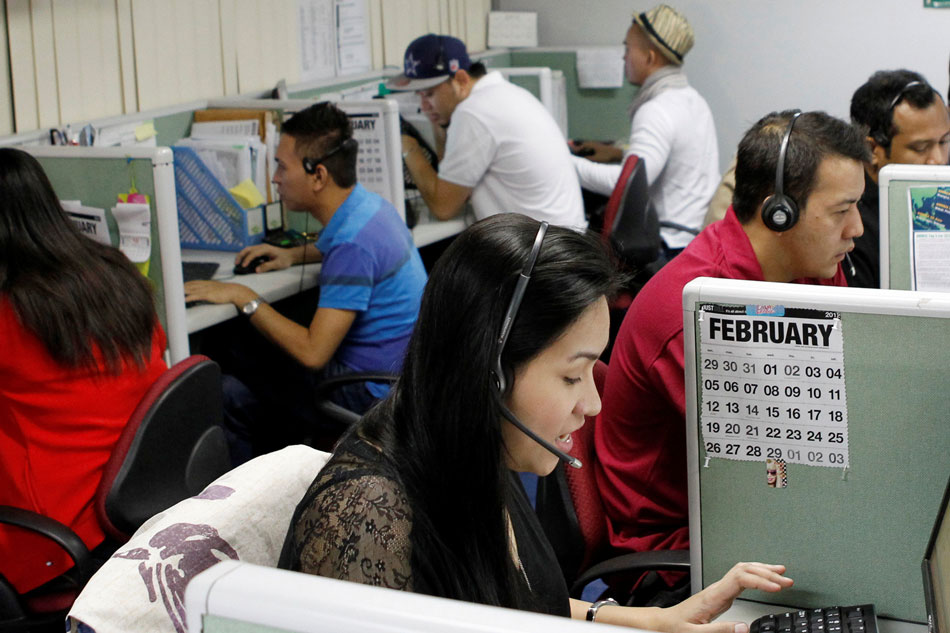
Business process outsourcing is an economic lifeline in the Philippines with over 1.15 million Filipinos working in the industry. File photo

MANILA - The Philippines is the second top globalization destination in the world this year, according to global strategic advisory firm Tholons.

The 2018 Services Globalization Index saw the Philippines rising to the second spot of the "Top 50 Digital Nations" after placing third last year.

India continues to dominate the list while Brazil follows the Philippines at third place.

Other countries in the top 10 are the United States, Mexico, Canada, Russia, Vietnam, Colombia, and South Africa.

"Most of the services will get commoditized for the biggest leaders in services globalization like US, UK, Canada, Europe, India, Philippines, East Europe, and Latin America," the index report stated.

Business process outsourcing is an economic lifeline in the Philippines with over 1.15 million Filipinos working in the industry.

The industry, along with remittances from overseas workers, remains one of the top 2 earners of foreign exchange for the Philippines.

SUPER CITIES

Six cities from the Philippines, meanwhile, made it to the "Top 100 Super Cities," with Manila placing second to Bengaluru in India.

The Philippine capital, which ranked fourth in 2017, is followed by the Indian city of Mumbai, which ranked third.

The rest of the Philippine cities included in the list all saw an improvement in their respective rankings.

Close to the top 10 is Cebu City, which ranked 11th from 12th last year, while President Rodrigo Duterte's hometown Davao City went 10 notches higher to the 75th spot from 85th last year.

Santa Rosa City in Laguna rose to the 87th spot from 100th last year while Bacolod City climbed to the 89th spot from 97th in 2017.

The Visayan city of Iloilo, meanwhile, is a newcomer to the list, landing at the 92nd spot.

The index evaluates and ranks countries and cities based on availability and quality of talent in the area, business catalyst or the level of industry-related activity and organizational support, cost of doing business, infrastructure, innovation, and risk and quality of life among others.


Friday, October 19, 2018

Asia's Top Goalscorers

Asia’s Top 5 active goalscorers for flag and country

Earl Averilla
Foxsports.ph
19 October 2018


Scoring for ones national team is an achievement, even for strikers, considering the less frequency of international football matches taking place and the chances of getting called up. But scoring goals for the flag on a relatively regular basis is definitely remarkable.
Without further delay, here are the Top Five active goalscorers in Asia.
5. Chan Siu  Ki (Hong Kong – Striker, 37 goals)
Chan Siu Ki Hong Kong Asian Top ScorerThe towering forward was able to translate his club form onto the international stage, amassing a total of 37 goals in 67 competitive appearances for an average of 0.55 goals per game and making him the current top scorer for The Dragons.
Recently experiencing a drop in his goal hauls, if he can regain back a bit of his old lethal self with his current club Hong Kong Pegasus FC, the 33 year old could still have a slight chance of getting a call-up and increase that tally of his national squad.
4. Ismail Abdul-Latif (Bahrain – Striker, 39 goals)
Ismail Abdul-latif Asian Top Scorer
The Bahraini finisher currently plays for Al Muharraq Sports Club. At 32 years old, he can still technically very much increase his tally if ever he can earn himself a national team call-up and break to the starting eleven.
But call-up or not, he has already achieved a notable number of goals scored for Bahrain at 39 goals in 112 caps at a respectable rate of 0.35 goals per game taking into consideration the very competitive West Asian zone.
As an individual player, he is notable with coming up with the occasional “special goals” worthy of making the highlight reel, as evidenced by an overhead strike that he was able to successfully convert for his former club, Al Salmiya SC sometime in 2004.
3. Sebastian Soria (Qatar – Striker, 40 goals)
Sebastian Soria is currently Qatar’s top goalscorer with 40 goals in 119 appearances (also a national record). He is currently playing for Qatari club Al-Rayyan.
At club level, Sebastian holds an Asian footballing record, particularly in the AFC Champions League, for the fastest goal scored in the tournament’s history as he was able to convert within nine seconds of the match when playing for Lekwhiya SC in 2013
At this moment, at 34 years of age, earning call-ups for his country could be at an end for the target man but even if he is not able to increase his tally, it would still take some time for it to be overtaken as the closest number of goals from an active player is only at 22 by Hassan Al Haydos of Al-Sadd.
2. Phil Younghusband (Philippines – Forward/Attacking Midfielder, 51 goals)
Phil Younghusband Azkals
The only active player from Southeast Asia who made the list, Phil Younghusband (currently of Filipino club Davao Aguilas Bellmare) is one of the instrumental players who put the Philippines, then considered a minnow, back on the footballing map after decades of being one of the cellar-dwellers of the world.
His upbringing in England as part of Chelsea Youth (along with his brother James, who also plays as midfielder for the Philippines), his addition to the national team in 2005 provided the quality that significantly boosted an already improving squad.
Initially playing mainly as a striker, Phil was able to reinvent himself by adding the ability to play as an attacking midfielder and as a set-piece specialist. And with his current form, it seems that he’s still on-track for further call-ups to represent the Philippines and increase his goal tally of 51 goals and record 99 caps (just one short of another milestone).
Now talk about a player who was discovered eligible to play for the Philippines through a video game.
1. Sunil Chhetri (India – Striker, 65 goals)
Sunil Chhetri India Asian Top scorer
Captain Fantastic! Need we say more?
Of course, just to further cement his LIVING LEGEND status. Whether club or country, Sunil Chhetri is a proven goal scorer with an average of a goal every other game for club football and an even more impressive 0.63 goals per game for The Blue Tigers.
In his home country, he is one of the most recognizable personalities and definitely the biggest ambassador for the growth of local football in a nation where cricket is still the dominant team sport.
But with India making waves and continuing to rise as a footballing power in Asia with Sunil at the forefront, capped by the 2019 Asian Cup qualification and the nation’s highest ever FIFA ranking – cracking the top 100, we definitely are witnessing someone who is very much worthy to be considered one of the greats in Asian football.

Wednesday, October 17, 2018

Global Food Security Index gainer

Philippines moves up on Global Food Security Index


Philstar.com
17 October 2018 


MANILA, Philippines — As the country suffers from rising food prices due to tight supply of basic goods, a global metrics on food security believes the Philippines has improved its capacity to feed its people. 

According to the Global Food Security Index this year, the country ranked 70th out of 130 countries, with a score of 51.5 over 100, with 100 being most favorable and food secure.

This was an improvement from last year's 79th placing with a score of 47.3.

The report, released on Wednesday, comes as the economy battles a near decade-high inflation propelled by supply constraints from rice, meat, vegetables and even fish.

The index, compiled by think tank Economist Intelligence Unit (EIU), measures each territory's capacity to ensure food supply among its populace. The index captures food affordability, availability, and quality and safety.
It also covers as criterion natural resources and resilience, showing why "climate risk mitigation" needs to be "developed and implemented around the globe to ensure food security amid the rising prevalence of climate risks."

City-state Singapore tops this year's report, while Burundi was at the bottom.

The Philippines ranked 70th out of 130 countries, with a score of 51.5 over 100. Philstar.com, file

Climate change could reverse Gain

While the report did not explain what accounts for the Philippines' improvement, it noted how lower-middle and low-income countries "experienced the most substantial gains over the past year."

However, the report also pointed out that recent gains are under threat to be reversed due to environmental and socioeconomic risks.

Among the criteria used in the index, the Philippines' score on natural resources and resilience inched down 1 point to 51 this year.

"Climate change will affect food production for all physical systems—marine and terrestrial—as basic environmental conditions shift," EIU said in the report.

"Understanding these risks and how to address them are essential to building food systems resilience and thereby ensuring food security for future generations," it added.

The Philippines is visited by an average of 20 typhoons each year, causing billions in damage to crops and livelihood that lessen harvests and food supply.

Just last month, typhoon Ompong, the strongest to hit land this year, damaged nearly P25 billion in crops in north Luzon, mostly rice. This, in turn, has tightened supply of the the main staple further, pushing prices up.

Among other Southeast Asian countries, the Philippines is ahead of Myanmar and Cambodia, which ranked 82nd and 85th, respectively.

Aside from top-placer Singapore, the country fell behind Indonesia (65th), Vietnam (62nd), Thailand (54th) and Malaysia (40th). Other countries in the region were not included in the report.

WEF Philippine Ranking 2018


Philippines and India rise in global competitiveness

World Economic Forum evaluates improvements in infrastructure and innovation

The Philippines moved up 12 rungs to 56th place in World Economic Forum's The Global Competitiveness Index 4.0.    © Reuters

TOKYO -- The World Economic Forum's latest global competitiveness list shows a positive picture in Asia, with the Philippines and India moving up the ranks.

The Global Competitiveness Report 2018, published on Wednesday, showed the Philippines rising 12 rungs from last year to 56th of a total of 140 countries and regions, based on a new methodology applied to both years. India also rose five places to 58th, making the largest gain among G-20 economies.

WEF used a new methodology in its latest edition to include elements that determine productivity. Of the 98 indicators, 34 were retained from the previous methodology while the other 64 indicators are new, resulting in new updated list for 2017.

Economic growth in the Philippines exceeded 6%, along with China, Cambodia and two other countries in Southeast Asia. The WEF also noted that the country's safety improved over the year, with scores in indicators including organized crime, homicide rate and incidence of corruption rising.

It ranked 21st in social capital.

The country's infrastructure such as airport and shipping connectivity improved as well. On the other hand, the Philippines still needs to enhance education, its product market as well as its workforce, the report shows.


India was ranked 8th in "quality of research institutions." The Geneva-based WEF highly evaluates the country noting "a remarkable example of a country that has been able to accelerate on the pathway to innovation, due, particularly, to the quality of its research institutions."

The ease of doing business in India has also improved. The cost of starting a business has come down and time to start a business has shortened over the year. The report expects further improvements in India's health sector which ranks 108th and skills sector which stands at 96th.

Singapore topped the Asian chart and was second globally behind the U.S. The report says the "openness [of the city-state] is the defining feature of this global trading hub and one of the main drivers of its economic success." Its infrastructure, health and product markets also topped the ranks.

Japan rose three places to 5th. It is the most improved of the top 10 countries and regions, ranking first in health, digital and physical infrastructures.


Japan is one of the region's key innovation hubs along with South Korea and Taiwan. However, the report said they "could improve on the so-called 'softer' drivers of innovation to attain the level of 'super innovators,'" such as Germany, the U.S. and Switzerland, as Japan scores fairly low on risk aversion, meaning not taking enough risks, and critical thinking. Japan has also room to improve its levels of social capital and corporate governance.

China kept its ranking at 28th, Hong Kong came in 7th overall and third in Asia. It is comparable to Singapore but the report noted that it scored "slightly less well in terms of innovation and labor market efficiency." Its sea port infrastructure and connectivity ranked first, while ICT adoption and financial system had high scores as well.

Taiwan also remained in the same ranks at 13th, while its macroeconomic stability scored it at 100. Its innovation capability was at 4th place, with abundant international co-inventions and cluster development.


South Korea rose up to 15th place, up two rungs compared with the 2017 edition, thanks to its leading position in ICT adoption. Its R & D expenditure is the second highest after Israel, at the equivalent of 4.2% of its gross domestic product. The report suggests the country can improve in entrepreneurial risk-taking and employee empowerment.

Malaysia, Thailand and Indonesia all rose in their ranks but Vietnam fell three places to 77th.

Thursday, October 11, 2018

The Best Islands in Asia 2018

Siargao, Boracay, Palawan rank 1-2-3 in travel magazine’s list of best islands in Asia


ABS-CBN News
11 October 2018

Boracay is scheduled to reopen to tourists late this month. Pictured is Puka Beach, on the island’s western coast, during the rehabilitative period in May. File/Fernando G. Sepe, Jr., ABS-CBN News
The Philippines once again claimed several spots in the annual world ranking of “best islands in the world,” according to travel and lifestyle magazine Condé Nast Traveler.

Siargao, Boracay and Palawan, in that order, took the top three spots in the “best in Asia” subcategory, as determined by the publication’s 2018 Reader’s Choice Awards.

Image result for siargao
SIARGAO. Picture: kermitsiargao.com

Image result for boracay
BORACAY. Picture: Philippine Star

Image result for palawan
PALAWAN. Picture: Stuff.co.nz

Booming Siargao was noted for its surf breaks and white sand, Boracay for its “gentle coastlines and made-for-Instagram sunsets,” and Palawan for its “otherworldly” subterranean river and blue lagoon.

Trailing the islands from the Philippines are Langkawi in Malaysia, and Bali in Indonesia.

This year, the 30-item worldwide list was divided into smaller groups of five, by region: Asia, Australia and the South Pacific, Caribbean and the Atlantic, Europe, North America, and “the rest of the world.”

Friday, October 5, 2018

Miss Asia-Pacific International 2018

Philippines’ Sharifa Akeel crowned Miss Asia Pacific International 2018


ABS-CBN News
Oct 05 2018


MANILA — The Philippines’ Sharifa Akeel was crowned Miss Asia Pacific International 2018 early Friday, making her the fifth Filipino to win the 50-year-old international pageant.


Related image


The Sultan Kudarat beauty bested 49 other candidates at the conclusion of the four-hour finals night held at the Newport Performing Arts Theater in Pasay Thursday.

Akeel succeeds Francielly Ouriques of Brazil.

Her runners-up, in order, were Gabriela Palma of Brazil, Melania Gonzales of Costa Rica, Misheelt Narmandakh of Mongolia, and Marani Angarita of Venezuela.

Miss Philippines Sharifa Akeel is crowned Miss Asia Pacific International 2018 by Francielly Ouriques of Brazil. Jonathan Cellona, ABS-CBN News
Prior to Akeel, four Filipinos were crowned in past iterations of the international pageant: Maria del Carmen Ines Zaragoza (1982), Gloria Dimayacyac (1983), Lorna Legaspi (1989), and Michelle Aldana (1993).

Established in 1968, Miss Asia Pacific International evolved over the decades to include candidates from more countries, having originally gathered only representatives from Asia and Oceania.

Pinoy farmer finalist in International Cocoa Awards

Filipino farmer makes it to the finals of 2019 International Cocoa Awards Antonio Colina Manila Bulletin 18 August 2019 DAVAO CITY ...