Wednesday, April 10, 2019

PH economic boom

Economic Boom Lifts More People Out of Poverty in Philippines


The ranks of the poor in Philippines are moderating as the nation sustains among the fastest economic growth in the region.

A man teaches a dance lesson at the SM Mall of Asia complex in Pasay City, Metro Manila.
Photographer: Hannah Reyes Morales/Bloomberg 
Filipinos living below the poverty line were estimated at 21 percent of the population in the first half of 2018 compared with 27.6 percent in the same period in 2015, the Philippines Statistics Authority said in a report on Wednesday. The poverty incidence, based on a survey conducted every three years, eased even as inflation accelerated last year.

Poverty declined as infrastructure projects created new jobs and the state expanded its cash handouts. “Thanks to sustained economic growth and critical and broad-based reforms and investments that have translated to employment-generation and social protection,” according to Economic Planning Secretary Ernesto Pernia.
The Philippines is working to meet its target of reducing the poverty rate to at least 14 percent by the end of President Rodrigo Duterte’s term in 2022, his spokesman Salvador Panelo said. To meet that goal, at least a million Filipinos must be lifted from poverty each year. The nation can become an upper middle-income country this year, ahead of its 2022 target, Pernia said.

Highlights

  • The poverty threshold -- the minimum amount a family of five must have to meet basic food and non-food needs -- is pegged at 10,481 pesos ($201) a month in the first half of 2018. That’s 11 percent more than in the first half of 2015.
  • Filipino families with incomes below the poverty line were estimated at 16.1 percent in the first half of 2018 . That’s less than 22.2 percent in 2015.
  • Subsistence incidence or the ratio of Filipino families with incomes below the food threshold of 7,337 pesos a month was estimated at 6.2 percent. That compares with 9.9 percent in 2015.
  • Poverty incidence was highest in the Autonomous Region in Muslim Mindanao in the south and lowest in Metro Manila.

Get More

  • The International Monetary Fund forecasts that the Philippines will grow 6.5 percent this year and 6.6 percent in 2020.
  • Self-rated poverty rose in the third quarter of 2018 with more than half of Filipino families considering themselves poor, according to a Social Weather Stations poll.
— With assistance by Siegfrid Alegado, Claire Jiao, and Andreo Calonzo


Taiwanese motors in PH

Kymco plans to build P1-B facility in Philippines

By Janina C. Lim, Reporter Business World
10 April 2019

KYMCO Philippines, Inc. is planning to put up a P1-billion facility in the country to boost its current capacity to meet growing demand and to allow future expansion into electric motorcycles.

In a press briefing in Makati City on Wednesday, Kymco Philippines President Allan B. Santiago said the company is looking to build the facility in north or south Luzon, particularly Laguna and Batangas due to their proximity to the Batangas port.
The local unit of Taiwan’s Kwang Yang Co. Motors Ltd. expects to start construction of the facility next year, and targets to operate by 2022 or 2023. The facility will have a monthly production of 6,000 up to 20,000 units.
“After about a decade of operations in the country, we have seen the potential and economic opportunities that the Philippines has to offer, and we believe that it is high time for us to take our presence and commitment to the next level… We are exerting more effort with our plan to bolster our investment in both the Philippine market and Filipino labor,” Mr. Santiago said.
Kymco Phillippines’ current capacity at its 250-hectare plant in Taguig City stands at 5,000 units per month. Monthly sales currently reach more than 1,500 units.

New Human specie found in Philippines

Previously Unknown Human Species Discovered in the Philippines

The discovery of Homo luzonensis suggests the history of human evolution is more complicated than we thought.
History


Beneath the rocky floor of Callao Cave on Luzon island in the Philippines, researchers have uncovered a number of fossils from what they believe is a previously unknown ancient human species.
Dubbed Homo luzonensis, the newly identified species inhabited Luzon more than 50,000 years ago, during the Late Pleistocene epoch. This means they shared the Earth with other relatively advanced hominins, including Homo neanderthalensis (a.k.a. Neanderthals) and Homo sapiens, or modern humans. These early humans lived in the same region and at the same time as the previously known “Hobbit” species, Homo floresiensis, and their tiny teeth suggest they may have been even shorter—possibly under three feet tall. But their tooth and foot shape, along with other traits, mark them as a distinct species all their own. 
Scientists have known for a while that generations of ancient hominins called this island in Southeast Asia home. Back in 2007, archaeologists in Luzon discovered a single foot bone (or metatarsal) in Callao Cave, which they dated to 67,000 years ago. Analysis of that fossil suggested it belonged to a member of the genus Homo, but they didn’t know which species. 
Excavation work inside the Callao Cave in Luzon.
In later excavations, conducted in 2011 and 2015, an international team of researchers led by Florent Détroit, of the Musée de l'Homme at the Natural History Museum in Paris, and Armand Mijares, of the University of the Philippines in Quezon City, found 12 more hominin bones and teeth in the same rock layer where the foot bone had been found. In their analysis of the fossils, published in Nature, they trace the remains to three different individuals, including at least one juvenile. 
The fossils found in the cave—including several foot and hand bones, a partial femur and teeth—shared some morphological features with more primitive hominin species such as Australopithecus and Homo erectus, as well as more advanced ones, including Homo sapiens and Homo floresiensis.
“What makes them a new species is actually the combination of all features taken together,” Détroit said in an email interview. “If you take each feature one by one, you will of course find it in one or several hominin species. But if you take the whole package, no other species of the genus Homo is similar, thus indicating that they belong to a new species.” 
Molars and premlars found of the Homo luzonensis.
In particular, the teeth found in Callao Cave differ from those of other known hominin species. The premolars have two to three roots, while in Homo sapiens, premolars usually have only one root, or two at the most. These distinct premolars, as well as the tooth enamel and dentin (the hard bony tissue that makes up the body of the tooth) are similar to Australopithecus and more ancient species of the genus Homo, such as Homo habilis and Homo erectus.
On the other hand, the molars are very small and simply formed, like those of modern humans. “An individual with these characteristics combined cannot be classified in any of the species known today,” said Détroit.
The foot bones identified as Homo luzonensis also stand out for their combination of primitive and developed features, which indicates members of the species might have had a distinctive way of walking. The proximal phalanx (which forms the base of the toe) is curved, with highly developed insertions for the muscles involved in the flexion of the foot.
“These characteristics do not exist in Homo sapiens,” Détroit pointed out. In fact, the foot bones found in Callao Cave are more similar to Australopithecus, which was known to live only in Africa some 2-3 million years ago. This suggests Homo luzonensis might (like Australopithecus) have had the ability to easily climb trees as well as walk upright on two legs, though it’s not clear whether they did so.
Though other Homo species are known to have inhabited the Southeast Asian islands, the researchers think Homo luzonensis were the only hominins present on Luzon at the time. The earliest Homo sapiens known in the Philippines are fossils discovered in Tabon Cave on Palawan Island, dated to 30,000 to 40,000 years ago at the oldest. By contrast, archaeologists recently unearthed stone tools and bones from a butchered rhinoceros in a valley near Callao Cave, suggesting that Homo luzonensis or its ancestors were on Luzon as many as 700,000 years ago.
Luzon is a large island and has never been accessible to the rest of the continent via land bridge. As a result, much of its flora and fauna are endemic (or restricted) to the island, with a relatively low genetic diversity. This phenomenon can rise to species that differ significantly from related species on the continent, the researchers argue—which explains why Homo luzonensis might look very different from its mainland hominin relatives.
At least a dozen species in the genus Homo have been identified so far, of which Homo sapiens is the only survivor. The exact number of early human species is a matter of debate, and has continued to expand over the years. Most recently, in 2012, scientists announced that fossils found in China belonged to a previously unknown early human species, which they called the Red Deer Cave people.
Like other recent discoveries that have expanded scientists’ understanding of human evolution (including the revelation that modern humans interbred not only with Neanderthals but with the mysterious ancient hominins known as Denisovans), Homo luzonensis and its distinct blend of features suggests the evolution of the Homo genus took many more twists and turns than previously believed.
“Fifteen years ago, human evolution in Asia was very simple, with Homo erectus going out of Africa, settling in East and Southeast Asia and nothing happening until the arrival of Homo sapiens at around 40-50,000 years ago,” Détroit said. “This finding is a significant new piece of evidence to improve our knowledge of human evolution, especially in Asia, where human evolution was clearly much more complex (and much more interesting) than what we thought before.” 


Tuesday, April 9, 2019

Pinoy films in Italy Filmfest

3 Pinoy film projects chosen at Italy film fest


Mye Mulingtapang, ABS-CBN News
Apr 09 2019


MILAN, Italy - Three Filipino film projects were selected for a co-production market at the Far East Film Festival (FEFF) in Udine, Italy.
"Everybody Leaves" by Phyllis Grae Grande and "The Grandstand" by Mikhail Red were chosen among 15 titles for Focus Asia, the festival's project market dedicated to genre cinema "with convincing potential for co-production and co-financing in Europe or Asia."
Grande's coming-of-age drama tells the story of a Japanese-Filipina exchange student who searches for her father in Japan, while Red's project is loosely based on the 2010 Quirino Grandstand hostage crisis.
"The Grandstand" also received in March the Focus Asia Award at the 17th Hong Kong Asia Film Financing Forum (HAF), a prominent film-financing platforms in Asia.
Meanwhile, Keith Deligero's "Babylon" was among 10 projects selected for Ties That Bind, a program design to assist producers in Asia with potential European-Asian co-production. The short film is about 2 girls who travel back in time to assassinate a village chief.
The projects were chosen out of 95 applications by a committee made up of specialists of genre films. Filmmakers will meet up with over 200 industry professionals, including financiers and distributors, in one-on-one meetings and other activities. 
The FEFF runs from April 30 to May 2.

Pinoy Planets

3 minor planets named after Pinoy students — DepEd 


Donna Magsino
GMA News
09 April 2019


An out of this world recognition was literally given to three outstanding Filipino students, as three minor planets in the universe were named after them after bagging an award from an international science fair, held in the United States.
According to a Facebook post of the Department of Education (DepEd) on Tuesday, the young scientists — Eugene Rivera, Joscel Kent Manzanero, and Keith Russel Cadores —from Camarines Sur National High School will forever have their names up in the sky, after their work in the design and development of Solar-Tracking Arduino-Rooted PV Panels won the second place award in the "Energy: Physical" category of the 2018 Intel International Science and Engineering Fair.
"Each received a certificate identifying their very own minor planet and an orbital plot showing its current location," DepEd said in a statement.

Since 2001, the Massachusetts Institute of Technology (MIT) Lincoln Laboratory has recognized high school students with exceptional knowledge in science by using their names as identifiers of the asteroids discovered by the laboratory.
Congrats, Eugene, Joscel, and Keith! Continue to reach for the sky!

Monday, April 8, 2019

PH companies expands in Asia


Sunday, April 7, 2019

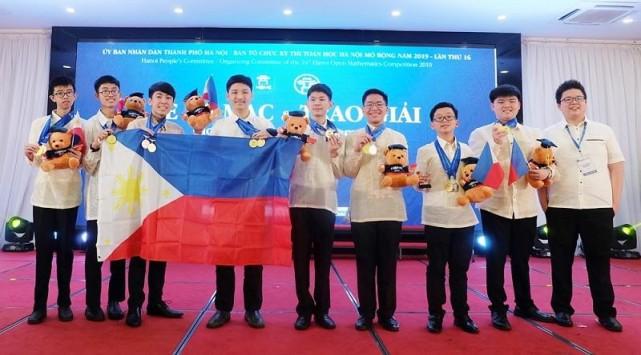
Pinoy Math wizzards in Hanoi

Pinoy students bag 10 medals at int'l math contest


Eight Filipino junior and senior high school students brought home the bacon after competing at an international math competition held in Vietnam this month, according to the Mathematics Trainers Guild-Philippines (MTG) on Sunday.
"This is the first international math contest for MTG students this year and we laud them for their achievement," said Dr. Isidro Aguilar, MTG president.
Congratulations!

Two of them bagged gold medals: Grade 10 students Bryce Ainsley Sanchez of Grace Christian College and Immanuel Josiah Balete of St. Stephen’s High School.
On the other hand, Grade 8 students Enzo Rafael Chan of Bayanihan Institute-Tarlac and Rickson Caleb Tan of MGC New Life Christian Academy won silver medals.
The bronze medalists were Cassidy Kyler Tan, Grade 8, Davao Christian High School; Noel Stephen Dequito, Grade 8, Xavier School Nuvali; Daryll Carlsten Ko, Grade 10, St. Stephen's High School; and Issam Wang, Grade 10, Manila Science High School.
Two more bronze medals were won by the Filipino students in the team contest.
From April 2 to 6, 2019, around 700 students from China, Hungary, Indonesia, Iran, Malaysia, Myanmar, Nepal, Philippines, Poland, Spain, Taiwan, Thailand, United Arab Emirates, and Vietnam participated in the said math competition organized by the Hanoi Department of Education and Training and Hanoi Mathematical Society. — LA, GMA News


Pinoy farmer finalist in International Cocoa Awards

Filipino farmer makes it to the finals of 2019 International Cocoa Awards Antonio Colina Manila Bulletin 18 August 2019 DAVAO CITY ...